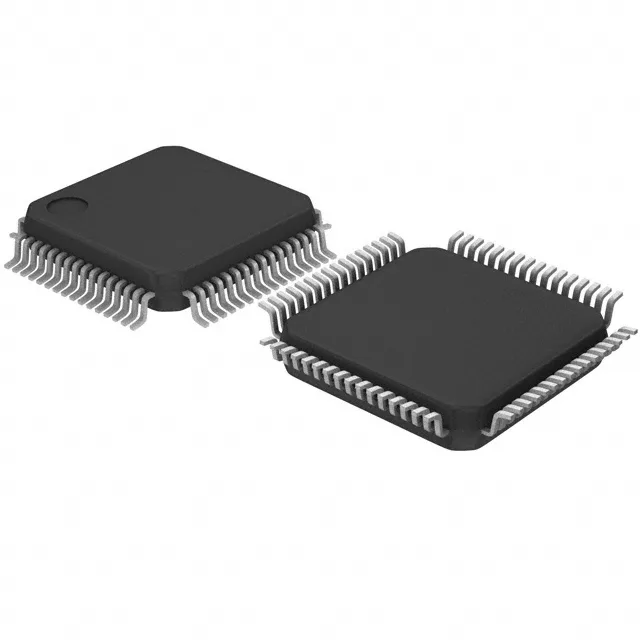
The STM32F103RDT6TR: At 72 MHz the ARM Cortex-M3 core delivers about 1.25 DMIPS/MHz, or roughly 90 DMIPS total. That is enough headroom for a real-time control loop (e.g., field-oriented motor control with the integrated PWM timer) while still handling USB or CAN traffic without a dedicated protocol coprocessor. The 64 KB SRAM supports moderate-sized data buffers — enough for a CANopen stack or a USB CDC class — but if your application needs large frame buffers or a full TCP/IP stack, you will want to budget the RAM carefully or move to a part with more SRAM.
384 KB Flash — firmware headroom and OTA staging
384 KB of on-chip Flash is the mid-density option in the STM32F103 line. It fits a typical industrial firmware image (RTOS kernel, USB stack, CAN driver, application logic) with room left for an OTA update staging area. The Flash is organized into 2 KB and 64 KB pages, so wear-leveling in the application layer is straightforward if you are writing configuration data frequently. For firmware-locked production, the Flash is one-time-programmable in the field only via the bootloader or SWD — no external EEPROM needed for code storage.
Connectivity and peripherals — one chip for the control node
The STM32F103RDT6TR includes CAN 2.0B, full-speed USB 2.0, and multiple UARTs with IrDA and LIN support, plus SPI and I²C. That makes it a single-chip solution for a CANopen or Modbus gateway, a USB-to-serial bridge, or a motor drive controller that talks to a host over CAN. The motor-control PWM timer has dead-time insertion and emergency stop inputs, so it can drive a three-phase inverter directly with minimal external logic. The 16-channel 12-bit ADC samples at up to 1 µs per channel — adequate for current sensing in a motor loop or for reading multiple analog sensors.
Package and mounting — 64-LQFP rework and storage notes
MSL 3 requires bake before reflow if the floor-life window is exceeded.
Lifecycle and supply — active, no LTB risk
STMicroelectronics lists the STM32F103RDT6TR as Active. The STM32F1 series has been in production for over a decade and remains a mainstream choice for cost-sensitive industrial designs. The part is ROHS3 compliant.