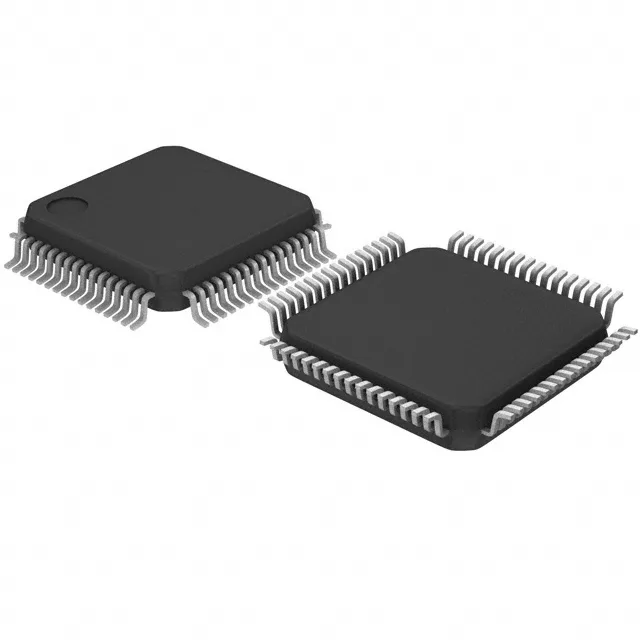
STMicroelectronics STM32F103RBT6 — Microcontrollers & Processors (MCU / MPU / DSP)

STMicroelectronics STM32F103RBT6 MCU, ARM Cortex-M3 72MHz

MPNSTM32F103RBT6
Active

STMicroelectronics STM32F1 series STM32F103RBT6, ARM Cortex-M3 32-bit MCU, 72MHz, 128KB Flash, 20KB SRAM, 51 I/O, CAN/USB/SPI/I2C, -40 to 85°C, 64-LQFP, Tray.

$7.5000Ref. price · indicative, final on quote
Packaging64-LQFP
RoHSROHS3 Compliant
SeriesSTM32F1
Independent supplier — new & surplus stockAuthenticity-screened · ESD-safe packingListing updated Aug 2026

Specifications

STM32F103RBT6 specifications
ParameterValue
SeriesSTM32F1
MountingSurface Mount
Oscillator typeInternal
Program memory typeFLASH
Voltage - supply (Vcc (Vdd))2V ~ 3.6V
Operating temperature-40°C ~ 85°C (TA)
Speed72MHz
PackageTray
RAM size20K x 8
Core size32-Bit Single-Core
PeripheralsDMA, Motor Control PWM, PDR, POR, PVD, PWM, Temp Sensor, WDT
ConnectivityCANbus, I2C, IrDA, LINbus, SPI, UART/USART, USB
Number of i (O)51
Core processorARM® Cortex®-M3
Case64-LQFP
Data convertersA/D 16x12b
Program memory size128KB (128K x 8)

Product details

72 MHz Cortex-M3 with 128 KB Flash — the mid-range workhorse

It belongs to the STM32F1 series, ST's mainstream Cortex-M3 line that balances performance, peripheral integration, and cost for industrial and consumer control applications. The part carries 51 general-purpose I/Os and a rich set of connectivity including CAN, USB, SPI, I2C, and multiple UARTs, making it a common choice for motor drives, PLC I/O modules, building automation controllers, and sensor hubs.

The 128 KB Flash is sized for moderate firmware — a full CANopen stack plus a USB CDC class driver leaves about 40 KB free for application code. The 20 KB SRAM supports a few 1 KB DMA buffers and a modest RTOS heap; if your design needs larger frame buffers or a TCP/IP stack, step up to the STM32F103RCT6 with 256 KB Flash and 48 KB SRAM. The CAN 2.0B interface is present (one channel), so no external CAN controller is needed for industrial bus nodes. The 12-bit ADC with 16 channels covers multi-sensor acquisition, and the motor control PWM timer with complementary outputs and dead-time insertion drives a three-phase inverter directly.

For dual-sourcing or a lower-power alternative, the STM32L151CBU6A shares the Cortex-M3 core and a similar peripheral set but runs at 32 MHz and targets battery-operated designs with 1.8 V operation. That part is not a pin-for-pin drop-in — it comes in a 48-pin package with 37 I/O — so a board respin is required.

Frequently asked questions

Does STM32F103RBT6 have CAN bus?

Yes, the STM32F103RBT6 includes one CAN 2.0B interface as part of its connectivity set, along with USB, I2C, SPI, and multiple UART/USART channels.

What is the maximum clock speed of STM32F103RBT6?

The STM32F103RBT6 runs at a maximum core clock speed of 72 MHz, driven from an internal oscillator or an external crystal.

What is the difference between STM32F103RBT6 and STM32F103RCT6?

The STM32F103RCT6 doubles the Flash to 256 KB and the SRAM to 48 KB compared to the 128 KB Flash and 20 KB SRAM of the STM32F103RBT6. Both share the same 72 MHz Cortex-M3 core, 64-LQFP package, and peripheral set. The RCT6 is the pin-compatible upgrade path if your firmware or data buffers exceed the RBT6's memory capacity.

When sourcing STM32F103RBT6, what's the closest functional second-source — STM32L151CBU6A?

The STM32L151CBU6A is a Cortex-M3 alternative from ST's ultra-low-power series, but it is not a pin-compatible drop-in. It runs at 32 MHz, operates from 1.8 V, and comes in a 48-pin package with 37 I/O — a board redesign is needed. The STM32L1 targets battery-powered applications; the STM32F103RBT6 targets performance-oriented industrial designs. For a same-package second source within the STM32F1 family, consider the STM32F103RCT6 (256 KB Flash) or the STM32F103VBT6 (100-pin LQFP) if more I/O is required.