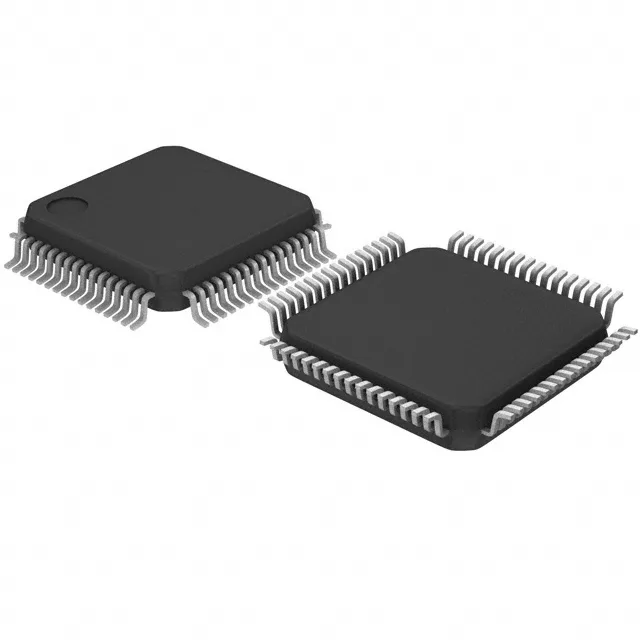
72 MHz Cortex-M3 with 64 KB Flash — the mainstream workhorse
It is the mainstream Performance line part — the one you reach for when you need a proven, well-documented MCU for motor control, industrial automation, or CAN-connected embedded systems. The 64-pin LQFP package gives you 51 I/O lines, a full set of timers including motor-control PWM, DMA, and a 16-channel 12-bit ADC.
Memory sizing — 64 KB Flash, 20 KB SRAM
64 KB of Flash and 20 KB of SRAM is the mid-density tier in the STM32F103 family. For a typical motor-drive application running field-oriented control with a CAN stack, that Flash holds the control loops and communication stack with room to spare. The 20 KB SRAM is enough for two 256-point sine lookup tables and a few hundred bytes of CAN mailbox buffers.
Connectivity and peripherals — CAN, USB, and serial interfaces
The CAN controller is a big differentiator versus many Cortex-M3 parts in this price tier — it lets you connect directly to industrial automation buses or automotive diagnostic links without an external CAN controller chip. USB is device-only (no OTG), but for data-logging or firmware-update-over-USB applications it works with the standard ST USB library. The three USARTs and two SPIs give enough serial bandwidth for a multi-sensor hub or a gateway node.
Lifecycle — still active, no LTB risk
The STM32F1 series has been in production for over a decade and is one of ST's highest-volume MCU families — the toolchain, firmware libraries, and community knowledge base are mature and well-documented.