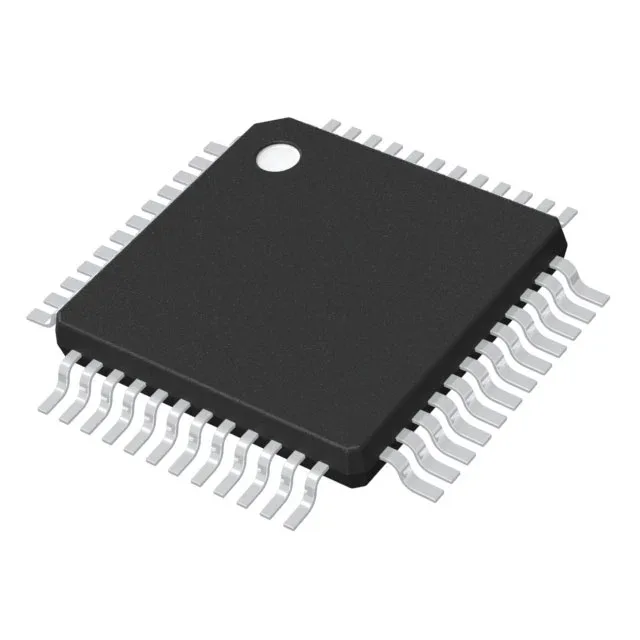
72 MHz ARM Cortex-M3 with 32 KB Flash — the entry-level industrial MCU
This is the entry-level density option in the STM32F103 line, sized for cost-sensitive control applications where the 72 MHz core handles real-time loops and the 32 KB Flash holds a modest firmware image.
Peripheral set and connectivity — CANbus, USB, and motor control PWM
This MCU integrates DMA, motor control PWM, and a full set of system supervisors (PDR, POR, PVD) plus a watchdog timer and temperature sensor. The connectivity block includes CANbus, I²C, SPI, UART/USART, USB, and IrDA — a mix that covers industrial fieldbus bridging, sensor aggregation, and human-machine interface links. The 37 GPIOs in the 48-LQFP package leave enough headroom for a keypad, a small character LCD, and a handful of discrete I/O without needing a port expander.
This is the deciding factor for designs that must survive cold starts in outdoor cabinets or heat soak inside a motor junction box. The commercial-grade STM32F103C6T6 (0°C to 70°C) would not hold up in those environments; the -T7 variant is the correct ordering code for the extended range.
Supply voltage and data converters
The 10-channel 12-bit ADC covers analog inputs like potentiometers, current shunts, or thermistor dividers without an external converter. An internal oscillator is available, though the PLL for the 72 MHz core clock typically uses an external crystal for accuracy.
The STM32F1 series remains a mainstream portfolio for ST, and the -T7 temperature grade is a standard offering with broad distributor stocking.