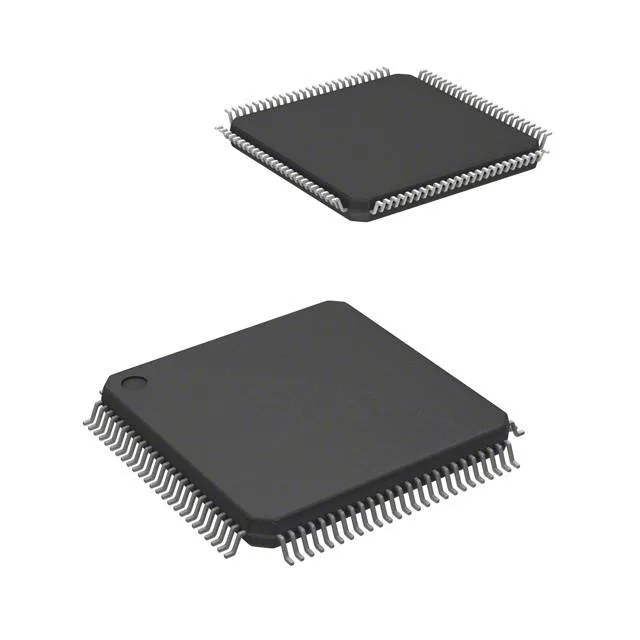
STMicroelectronics STM32F101VET6TR — Microcontrollers & Processors (MCU / MPU / DSP)

ST STM32F101VET6TR ARM Cortex-M3 MCU, 36 MHz, 512 KB Flash

MPNSTM32F101VET6TR
Active

STMicroelectronics STM32F101VET6TR, ARM Cortex-M3 32-bit MCU, 36 MHz, 512 KB Flash, 48 KB SRAM, 80 I/O, 100-LQFP, -40 to 85°C, Tape & Reel.

$6.2535Ref. price · indicative, final on quote
Independent supplier — new & surplus stockAuthenticity-screened · ESD-safe packingListing updated Jul 2026

Specifications

STM32F101VET6TR specifications
ParameterValue
SeriesSTM32F1
MountingSurface Mount
Oscillator typeInternal
Program memory typeFLASH
Voltage - supply (Vcc (Vdd))2V ~ 3.6V
Operating temperature-40°C ~ 85°C (TA)
Speed36MHz
PackageTape & Reel (TR)
RAM size48K x 8
Core size32-Bit Single-Core
PeripheralsDMA, PDR, POR, PVD, PWM, Temp Sensor, WDT
ConnectivityI²C, IrDA, LINbus, SPI, UART/USART
Number of i (O)80
Core processorARM® Cortex®-M3
Case100-LQFP
Data convertersA/D 16x12b; D/A 2x12b
Program memory size512KB (512K x 8)

Product details

36 MHz Cortex-M3 with 512 KB Flash — the cost-optimized F1 variant

It is deliberately positioned below the STM32F103 series — the same core and pinout, but with the clock halved and no USB or CAN interface. This makes it a clean fit for cost-sensitive industrial control, sensor hubs, and human-machine interfaces where the full peripheral set of the F103 would be overkill. The 100-LQFP package gives 80 GPIOs, enough for parallel displays, keypad matrices, or multiple motor-drive signals without an external port expander.

512 KB Flash, 48 KB SRAM — memory headroom for the BOM

The 512 KB Flash is generous for a 36 MHz part — large enough to hold a full application stack, bootloader, and field-update staging area. The 48 KB SRAM supports moderate RTOS tasks and data buffers; if your application streams camera frames or runs heavy DSP, the 64 KB SRAM of the STM32F103VET6 is worth the step up. The 12-bit ADC (16 channels) and dual 12-bit DAC handle analog sensing and control-loop output without external converters, keeping the BOM count low.

For a production line that needs a 32-bit MCU with a proven, well-documented architecture and no imminent obsolescence, this is a safe choice.

Supply and temperature grade

This covers most factory-floor, outdoor telecom, and automotive-cabin applications. The internal oscillator reduces external component count, though an external crystal is recommended if the 36 MHz PLL timing margin is tight.

Frequently asked questions

STM32F101VET6TR vs STM32F103VET6: what are the differences?

Both parts share the same ARM Cortex-M3 core, 512 KB Flash, 48 KB SRAM, 100-LQFP package, and pinout. The key difference is that the STM32F101VET6TR runs at 36 MHz and omits USB and CAN interfaces, while the STM32F103VET6 runs at 72 MHz and includes USB and CAN. The F101 is the cost-optimized version for applications that do not need the higher clock speed or those peripherals.

Does STM32F101VET6TR have USB interface?

No. The STM32F101VET6TR does not include a USB interface. Its connectivity is limited to I²C, IrDA, LINbus, SPI, and UART/USART. If USB is required, the pin-compatible STM32F103VET6 is the correct choice.