It is a value-line member of the family — the core runs at half the speed of the STM32F103's 72 MHz, which directly affects how you budget for interrupt latency and peripheral throughput. The 512 KB Flash is generous for a 36 MHz part; it supports firmware images with full protocol stacks (USB, CAN, or TCP offload) without external memory. The 48K x 8 SRAM is adequate for moderate data buffering and RTOS task stacks, but if your application needs large frame buffers or extensive DMA transfers, you will want to check the RAM budget against the peripheral set. The part includes a 12-bit ADC with 16 channels and a 2-channel 12-bit DAC, plus DMA, PWM, and a temperature sensor — a solid peripheral mix for industrial sensor nodes, motor-control interfaces, and general-purpose control logic.
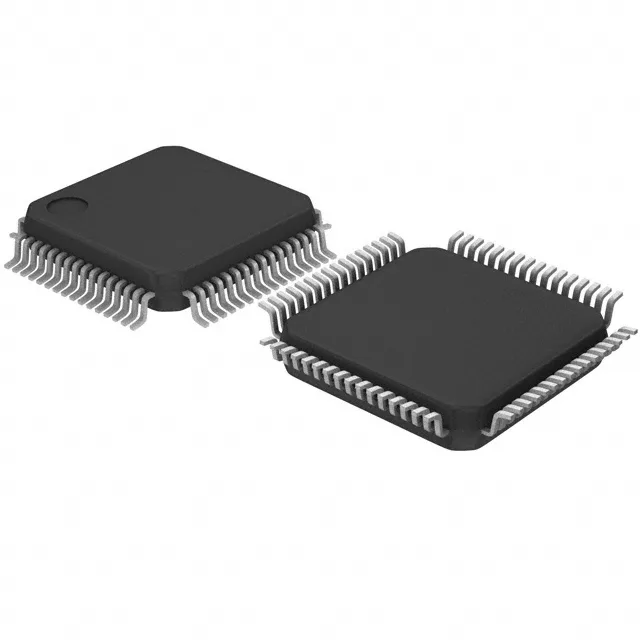
STM32F101RET6 ARM Cortex-M3 MCU, 512KB Flash, 36MHz, 64-LQFP
MPNSTM32F101RET6
Active
STMicroelectronics STM32F1 series, STM32F101RET6, ARM Cortex-M3, 32-Bit Single-Core, 36MHz, 512KB Flash, 48K x 8 SRAM, 64-LQFP, -40°C ~ 85°C.
$9.7300Ref. price · indicative, final on quote
Packaging64-LQFP
RoHSROHS3 Compliant
SeriesSTM32F1
Independent supplier — new & surplus stockAuthenticity-screened · ESD-safe packingListing updated Aug 2026
Specifications
| Parameter | Value |
|---|---|
| Series | STM32F1 |
| Mounting | Surface Mount |
| Oscillator type | Internal |
| Program memory type | FLASH |
| Voltage - supply (Vcc (Vdd)) | 2V ~ 3.6V |
| Operating temperature | -40°C ~ 85°C (TA) |
| Speed | 36MHz |
| Package | Tray |
| RAM size | 48K x 8 |
| Core size | 32-Bit Single-Core |
| Peripherals | DMA, PDR, POR, PVD, PWM, Temp Sensor, WDT |
| Connectivity | I²C, IrDA, LINbus, SPI, UART/USART |
| Number of i (O) | 51 |
| Core processor | ARM® Cortex®-M3 |
| Case | 64-LQFP |
| Data converters | A/D 16x12b; D/A 2x12b |
| Program memory size | 512KB (512K x 8) |
Product details
Frequently asked questions
What is the maximum frequency of STM32F101RET6?
The STM32F101RET6 runs at a maximum core frequency of 36 MHz. This is half the 72 MHz of the STM32F103 series, so budget accordingly for time-critical loops and peripheral throughput.
What is the closest pin-compatible alternative to STM32F101RET6 in the STM32F1 family?
The STM32F103RET6 is pin-compatible and offers the same Flash and SRAM sizes but runs at 72 MHz and includes a second ADC and a USB peripheral. If your design needs more throughput or USB connectivity, the F103 variant is a drop-in swap. The F101 is the cost-optimised choice when 36 MHz is sufficient.