It is built for cost-sensitive embedded control applications — motor drives, industrial sensors, building automation panels, and IoT edge nodes — where the 36 MHz ceiling keeps the core speed matched to the peripheral throughput rather than over-provisioned.
256 KB Flash, 32K x 8 RAM — sizing the firmware and data budget
The 256 KB Flash (256K x 8) and 32K x 8 SRAM define the firmware and runtime data envelope. For a typical motor-control or sensor-fusion firmware stack, 256 KB holds the application code plus a bootloader with room for OTA staging; 32 KB of RAM supports moderate-sized lookup tables, communication buffers, and real-time control variables. If the design needs more than 32 KB of volatile data — for example, a large frame buffer or extensive logging — this part will hit the ceiling, and the 72 MHz STM32F103 sibling with matching Flash but identical RAM won't help; you would step to a higher-density STM32F1 or F4 variant.
STMicroelectronics lists the STM32F101RCT6TR as Active. For production planning, that means no forced redesign window; the part can be qualified into a new BOM today with confidence that the supply channel will remain open through the typical product lifecycle. The ROHS3 compliance covers EU regulatory requirements without exemption paperwork.
Package and footprint — 64-LQFP, 10x10 mm
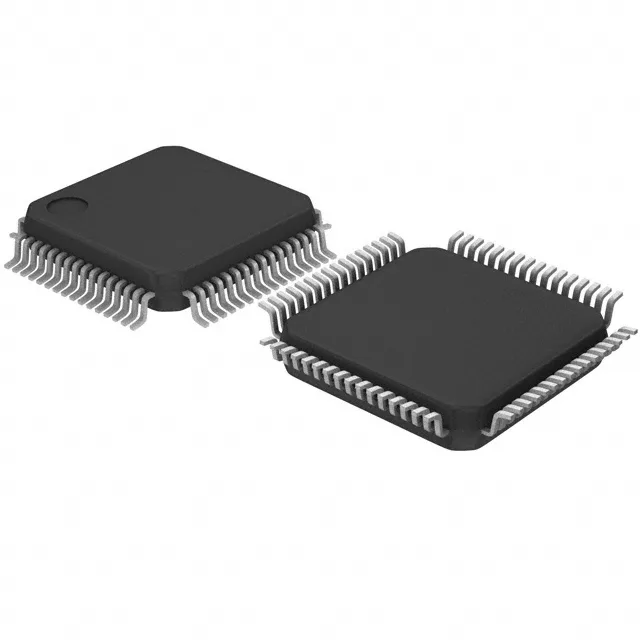
Housed in a 64-lead LQFP with a 10x10 mm body, the STM32F101RCT6TR uses a fine-pitch 0.5 mm lead pitch. Cut Tape (CT) is also available for prototype or low-volume builds.
The DMA controller offloads data transfers from the CPU, which matters at 36 MHz when servicing multiple high-rate peripherals simultaneously.