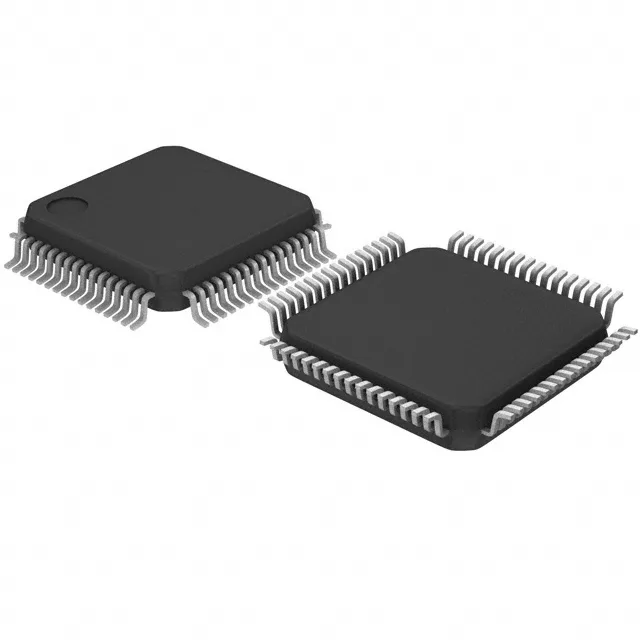
It targets cost-sensitive control applications where the full 72 MHz performance of the STM32F103 is not needed — think motor drive interface, sensor hub aggregation, or industrial I/O modules. The 64-LQFP package (10x10 mm) keeps board area tight, and the 51 general-purpose I/O lines cover most parallel bus or keypad scanning needs without a port expander.
The 36 MHz clock is half the speed of the STM32F103 sibling, but the Cortex-M3 pipeline still delivers 1.25 DMIPS/MHz. For a UART-polled sensor node or a PWM-driven fan controller that is plenty of headroom, and the lower frequency directly reduces dynamic current draw — useful in lightly regulated 3.3 V supplies where every milliamp counts.
256 KB Flash, 32 KB SRAM — sizing the firmware and data buffers
256 KB of program Flash is enough for a full RTOS kernel, a TCP/IP stack (if using an external PHY), and application logic without resorting to code compression. The 32 KB SRAM handles moderate-sized packet buffers or a double-buffered display frame; if your application needs more than that for data logging or image processing, step up to the STM32F103 with 48 KB or 64 KB RAM options. Flash is sector-erasable, so OTA update staging needs to fit within the available RAM or use a two-bank scheme.
The 64-LQFP package is a 10x10 mm body with 0.5 mm pitch — standard for hand assembly and inspection, but the fine pitch still calls for a soldering profile that avoids bridging on the corner pins. Surface-mount only, no through-hole option.
On-chip peripherals include DMA, multiple timers with PWM, a temperature sensor, and windowed watchdog. Connectivity covers I²C, SPI, and two UART/USART interfaces with IrDA and LINbus support — enough for a Modbus RTU node or a multi-sensor I²C bus.
If the line is gated by lead time, the STM32F103RCT6 is a pin-compatible 72 MHz alternative with the same Flash and RAM footprint, though it carries a higher unit cost.