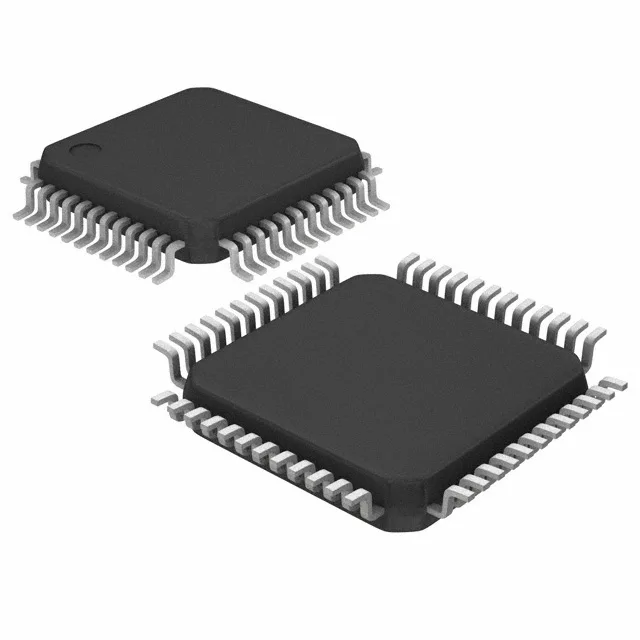
STMicroelectronics STM32F101C8T6TR — Microcontrollers & Processors (MCU / MPU / DSP)

STM32F101C8T6TR STM32F1 MCU, 36 MHz, 64 KB Flash, 48-LQFP

MPNSTM32F101C8T6TR
Active

STMicroelectronics STM32F1 series, STM32F101C8T6TR, ARM Cortex-M3, 32-bit, 36 MHz, 64 KB Flash, 10K x 8 RAM, DMA, PWM, 37 I/O, I²C, SPI, UART/USART, 2V to 3.6V, -40°C to 85°C, 48-LQFP (7x7), Tape & Reel.

$5.9500Ref. price · indicative, final on quote
Packaging48-LQFP
RoHSROHS3 Compliant
SeriesSTM32F1
Independent supplier — new & surplus stockAuthenticity-screened · ESD-safe packingListing updated Aug 2026

Specifications

STM32F101C8T6TR specifications
ParameterValue
SeriesSTM32F1
MountingSurface Mount
Oscillator typeInternal
Program memory typeFLASH
Voltage - supply (Vcc (Vdd))2V ~ 3.6V
Operating temperature-40°C ~ 85°C (TA)
Speed36MHz
PackageTape & Reel (TR) Cut Tape (CT)
RAM size10K x 8
Core size32-Bit Single-Core
PeripheralsDMA, PDR, POR, PVD, PWM, Temp Sensor, WDT
ConnectivityI2C, IrDA, LINbus, SPI, UART/USART
Number of i (O)37
Core processorARM® Cortex®-M3
Case48-LQFP
Data convertersA/D 10x12b
Program memory size64KB (64K x 8)

Product details

It's the access-line sibling in the STM32F1 family — lower clock speed and no USB or CAN, but the same Cortex-M3 core and peripheral set for cost-sensitive control applications. Typical deployment covers industrial sensors, motor-control interfaces, building automation, and any 3.3 V embedded system where 37 I/O lines and a 12-bit ADC (10-channel) are enough, and the budget doesn't stretch to the full-featured STM32F103.

The 36 MHz ceiling is half the speed of the STM32F103C8T6 (72 MHz). That's the trade-off: you lose throughput for a lower unit cost and slightly reduced power draw. For a UART-driven sensor hub or a PWM controller running at a few kilohertz, 36 MHz is plenty — the Cortex-M3 still handles 1.25 DMIPS/MHz. But if your loop needs tight timing on SPI or heavy math, the 72 MHz sibling is the better fit. The Flash wait state stays at zero at this clock, so no latency penalty on code fetch.

Memory sizing and field updates

64 KB of Flash and 10 KB of SRAM are the entry-level configuration for the STM32F101 series. That's enough for a modest application stack — a FreeRTOS kernel, a few peripheral drivers, and a command-line interface — but leaves little room for OTA staging or data logging. If you need to buffer sensor data or run a TCP/IP stack, the 128 KB or 256 KB variants (STM32F101R8, STM32F101RB) give more headroom without changing the core or pinout.

The supply range of 2V to 3.6V lets it run from two alkaline cells or a regulated 3.3 V rail — useful for battery-backed designs.

STMicroelectronics lists the STM32F101C8T6TR as Active. For dual-sourcing resilience, the STM32L151CBU6A (also Cortex-M3, 32 MHz, 37 I/O) is a functional alternative with lower power and USB, though it comes in a different package (UFBGA) and requires a firmware port for the peripheral differences.

Frequently asked questions

What is the replacement or equivalent for STM32F101C8T6TR?

The STM32F103C8T6 is a pin-compatible upgrade with 72 MHz core speed and USB/CAN peripherals, but it costs more. For a lower-power alternative, the STM32L151CBU6A is a functional equivalent with 32 MHz Cortex-M3, 37 I/O, and USB, though it comes in a UFBGA package and requires firmware changes for the peripheral set.

How to program STM32F101C8T6TR?

Programming is done via the Serial Wire Debug (SWD) interface using a standard ST-Link/V2 or J-Link debug probe. The internal bootloader also supports UART-based programming through USART1 (PA9/PA10). STM32CubeIDE, Keil MDK, or IAR EWARM all support this device.

Is STM32F101C8T6TR compatible with STM32F103C8T6?

Yes, the STM32F101C8T6TR is pin-compatible with the STM32F103C8T6 in the same 48-LQFP package. The main differences are the 36 MHz vs 72 MHz core speed and the absence of USB and CAN peripherals on the F101. A firmware port is required to use the F103's additional features.