The 112 GPIOs in a 144-LQFP package suit systems that need parallel interfaces or a high sensor count. On-chip peripherals include DMA, power-on reset, programmable voltage detector, PWM timers, a temperature sensor, and a watchdog timer — enough to handle motor drive sequencing, supervisory functions, and basic fault handling without external supervisor ICs. Connectivity covers I²C, IrDA, LIN, SPI, and UART/USART, which covers most industrial sensor buses, serial displays, and point-to-point links.
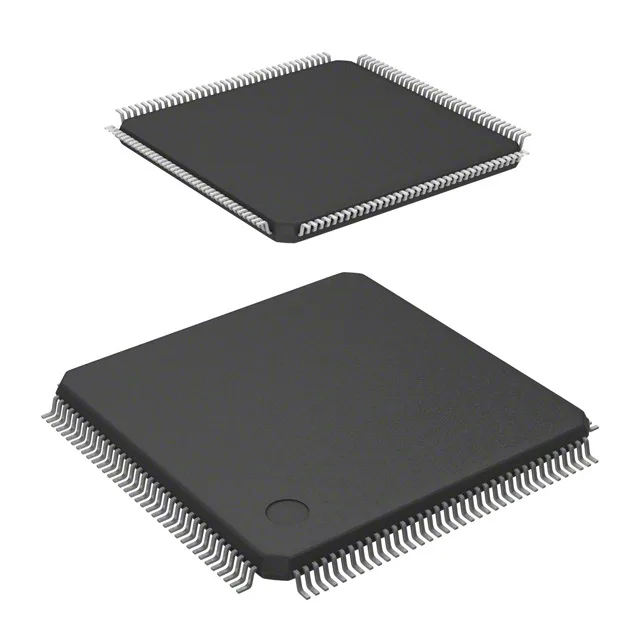
STM32F100ZET7B STM32F1 ARM Cortex-M3 MCU, 24 MHz
MPNSTM32F100ZET7B
Active
STMicroelectronics STM32F100ZET7B, STM32F1 series, 32-Bit Single-Core ARM Cortex-M3 MCU, 24 MHz, 512 KB Flash, 32K x 8 RAM, 112 I/O, 144-LQFP, -40 to 105 °C.
$8.5318Ref. price · indicative, final on quote
Independent supplier — new & surplus stockAuthenticity-screened · ESD-safe packingListing updated Jul 2026
Specifications
| Parameter | Value |
|---|---|
| Series | STM32F1 |
| Mounting | Surface Mount |
| Oscillator type | Internal |
| Program memory type | FLASH |
| Voltage - supply (Vcc (Vdd)) | 2V ~ 3.6V |
| Operating temperature | -40°C ~ 105°C (TA) |
| Speed | 24MHz |
| Package | Tray |
| RAM size | 32K x 8 |
| Core size | 32-Bit Single-Core |
| Peripherals | DMA, PDR, POR, PVD, PWM, Temp Sensor, WDT |
| Connectivity | I²C, IrDA, LINbus, SPI, UART/USART |
| Number of i (O) | 112 |
| Core processor | ARM® Cortex®-M3 |
| Case | 144-LQFP |
| Data converters | A/D 16x12b; D/A 2x12b |
| Program memory size | 512KB (512K x 8) |
Product details
Frequently asked questions
Does STM32F100ZET7B have a built-in ADC and how many channels?
Yes, it includes a 16-channel, 12-bit ADC and a dual 12-bit DAC, covering most analog input and output needs without external converters.
What is the difference between STM32F100 and STM32F103?
The STM32F100 is the value-line derivative of the STM32F103. The F103 runs at 72 MHz and offers up to 1 MB Flash and 96 KB SRAM, while the F100 is clocked at 24 MHz with up to 512 KB Flash and 32 KB SRAM. The F100 trades peak performance for lower cost and reduced power, but retains the same Cortex-M3 core and peripheral set. They are not pin-compatible across the full range — verify the specific package and pinout before substituting.