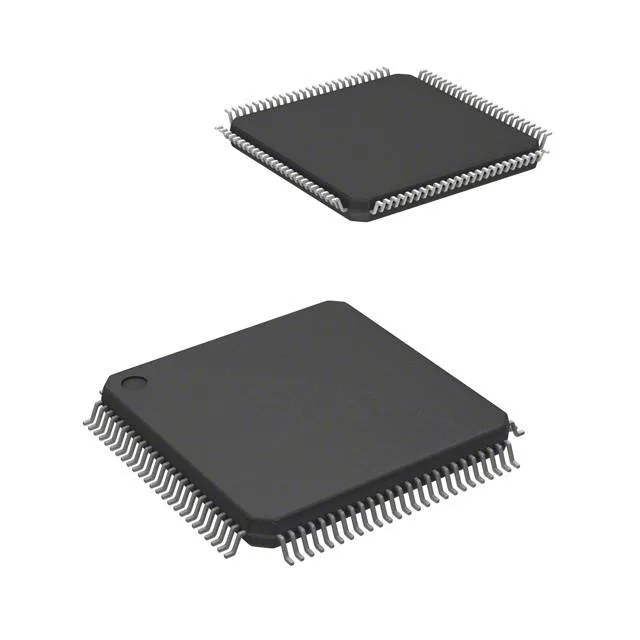
STMicroelectronics STM32F100VET7B — Microcontrollers & Processors (MCU / MPU / DSP)

STM32F100VET7B STM32F1 ARM Cortex-M3 MCU, 24MHz, 512KB Flash

MPNSTM32F100VET7B
Active

STMicroelectronics STM32F1 series STM32F100VET7B, ARM Cortex-M3 32-bit MCU, 24MHz, 512KB Flash, 32K x 8 RAM, 80 I/O, 100-LQFP, -40 to 105°C, 2V to 3.6V supply.

$7.0700Ref. price · indicative, final on quote
Independent supplier — new & surplus stockAuthenticity-screened · ESD-safe packingListing updated Jul 2026

Specifications

STM32F100VET7B specifications
ParameterValue
SeriesSTM32F1
MountingSurface Mount
Oscillator typeInternal
Program memory typeFLASH
Voltage - supply (Vcc (Vdd))2V ~ 3.6V
Operating temperature-40°C ~ 105°C (TA)
Speed24MHz
PackageTray
RAM size32K x 8
Core size32-Bit Single-Core
PeripheralsDMA, PDR, POR, PVD, PWM, Temp Sensor, WDT
ConnectivityI²C, IrDA, LINbus, SPI, UART/USART
Number of i (O)80
Core processorARM® Cortex®-M3
Case100-LQFP
Data convertersA/D 16x12b; D/A 2x12b
Program memory size512KB (512K x 8)

Product details

Peripheral set and integration — what the on-chip ADC and DAC mean for the BOM

The ADC's 12-bit resolution is adequate for many current-sense and temperature-monitor loops, while the DAC can drive a setpoint voltage for a regulator or an analog modulation input. Combined with the PWM timers and DMA, the part can run a sensor-to-actuator control chain entirely on-chip — useful in a pump controller, a variable-speed fan drive, or a simple servo axis where the 24 MHz loop rate is sufficient.

Frequently asked questions

What is the difference between STM32F100VET7B and STM32F103?

The STM32F100VET7B runs at 24 MHz, while the STM32F103 series runs at 72 MHz — the F103 offers roughly three times the core throughput for compute-heavy tasks. The F100 value line targets cost-sensitive control applications where the lower clock speed is acceptable, and it omits some high-speed peripherals found on the F103. Both are ARM Cortex-M3 based and share the same 100-LQFP pinout, so a board can often accommodate either with a firmware change.

What is the replacement for STM32F100VET7B?

There is no official replacement because this part is still active in production. If a design needs more performance within the same footprint, pin-compatible STM32F103 devices in the 100-LQFP package offer a 72 MHz core and additional peripherals, though the firmware and clock tree must be reworked.

How to program STM32F100VET7B?

The STM32F100VET7B supports standard ARM Serial Wire Debug (SWD) through its dedicated debug pins, plus USART bootloading via the built-in system memory bootloader. ST's STM32CubeProgrammer, Keil MDK, IAR EWARM, and open-source tools like OpenOCD can all program it through SWD. The internal oscillator is enabled by default, so a minimal board with power, ground, SWD, and BOOT0 strapping can start programming immediately.