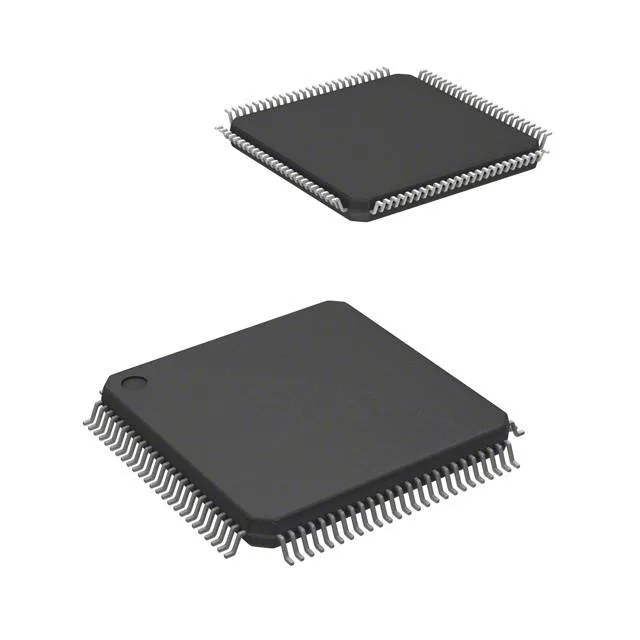
Value-line Cortex-M3 for cost-sensitive control
This is the part you pick when the BOM needs a capable controller without paying for the 72 MHz performance tier — it is the cost-optimised sibling for control-loop, sensor-fusion, and communication-gateway tasks where throughput is secondary to power and unit cost.
Peripheral set and connectivity — what is on board
The STM32F100VET6BTR integrates a full set of peripherals: DMA, programmable voltage detector (PVD), power-on reset (POR), brown-out reset (PDR), PWM timers, a temperature sensor, and a watchdog timer. Two 12-bit DACs and sixteen 12-bit ADC channels handle analog I/O without external converters.
At 24 MHz the core runs at roughly one-third the speed of the mainstream STM32F103 series. That is the trade-off: you lose throughput for lower dynamic current and a cheaper silicon die. For a thermostat, a CAN bridge, or a pump controller that polls sensors at kilohertz rates, 24 MHz is plenty. For a display buffer or real-time FFT, you want the faster sibling.
Not rated for under-hood or downhole environments where junction temperatures exceed 105 °C. The 100-LQFP package is a 14x14 mm body with 0.5 mm pitch — standard for reflow assembly, but the fine pitch means the PCB fab needs a decent solder mask alignment.
That means no last-time-buy pressure and no forced redesign for the foreseeable future.