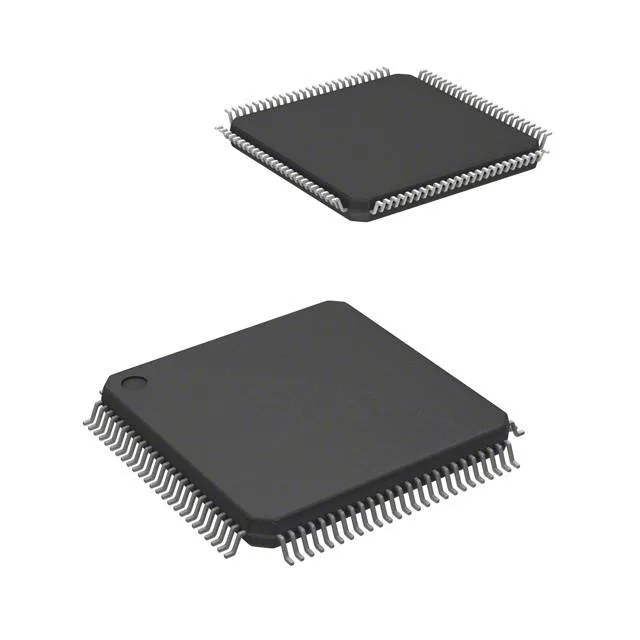
STMicroelectronics STM32F100VDT7B — Microcontrollers & Processors (MCU / MPU / DSP)

STM32F100VDT7B ARM Cortex-M3 MCU, 24 MHz, 384 KB Flash

MPNSTM32F100VDT7B
Active

STMicroelectronics STM32F1 series, ARM® Cortex®-M3, 32-Bit Single-Core, 24MHz, 384KB (384K x 8) FLASH, 32K x 8 RAM, 100-LQFP, -40°C ~ 105°C.

$6.2501Ref. price · indicative, final on quote
Independent supplier — new & surplus stockAuthenticity-screened · ESD-safe packingListing updated Jul 2026

Specifications

STM32F100VDT7B specifications
ParameterValue
SeriesSTM32F1
MountingSurface Mount
Oscillator typeInternal
Program memory typeFLASH
Voltage - supply (Vcc (Vdd))2V ~ 3.6V
Operating temperature-40°C ~ 105°C (TA)
Speed24MHz
PackageTray
RAM size32K x 8
Core size32-Bit Single-Core
PeripheralsDMA, PDR, POR, PVD, PWM, Temp Sensor, WDT
ConnectivityI²C, IrDA, LINbus, SPI, UART/USART
Number of i (O)80
Core processorARM® Cortex®-M3
Case100-LQFP
Data convertersA/D 16x12b; D/A 2x12b
Program memory size384KB (384K x 8)

Product details

24 MHz Cortex-M3 with 384 KB Flash — the control-loop sweet spot

Connectivity and analog integration — reducing external BOM count

The 16-channel 12-bit ADC samples at sufficient rate for current-sense and thermistor monitoring in a motor-drive loop; the two 12-bit DACs can generate analog setpoints or bias voltages directly, saving an external DAC package.

Package footprint and board-level reuse

Housed in a 100-LQFP (14x14 mm) with 0.5 mm pitch, this package is shared across several STM32F1 value-line density options, so a single PCB layout can host multiple Flash/RAM variants by swapping the MCU. Surface-mount assembly is standard; no exposed pad means thermal dissipation depends on the leadframe and copper area on the top layer.

It is not listed as NRND or nearing end-of-life, so new designs can proceed without an immediate last-time-buy clock. The date-code and marking consistency should be verified on receipt — the 100-LQFP package is a common target for re-marked parts in the gray market, so a decap or X-ray check is prudent if the lot trace does not match the authorized chain.

Frequently asked questions

What is the difference between STM32F100VDT7B and STM32F100RDT6?

The STM32F100VDT7B comes in a 100-pin LQFP package with 80 I/O lines, while the STM32F100RDT6 is a 64-pin LQFP with fewer I/O. Both share the same 24 MHz Cortex-M3 core, 384 KB Flash, and 32K x 8 RAM, but the VDT7B offers more GPIO and the larger package for designs that need the extra pins.

Can STM32F100VDT7B replace STM32F100VBT6?

The STM32F100VBT6 has 128 KB Flash, while the VDT7B has 384 KB Flash. Both are 100-pin LQFP with the same core and peripheral set, so the VDT7B is a drop-in hardware replacement with triple the program memory — firmware needs recompilation for the larger Flash map, but the pinout and register layout are identical.