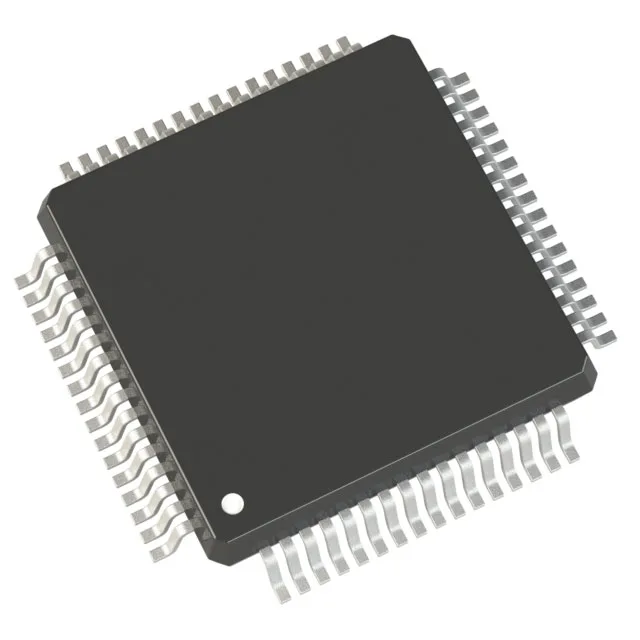
STMicroelectronics STM32F100R4T6BTR — Microcontrollers & Processors (MCU / MPU / DSP)

STM32F100R4T6BTR STM32F1 MCU, ARM Cortex-M3, 24 MHz

MPNSTM32F100R4T6BTR
Active

STMicroelectronics STM32F1 series, STM32F100R4T6BTR, ARM Cortex-M3, 32-Bit Single-Core, 24MHz, 16KB (16K x 8) FLASH, 4K x 8 RAM, 64-LQFP, -40°C ~ 85°C.

$5.1200Ref. price · indicative, final on quote
Packaging64-LQFP
RoHSROHS3 Compliant
SeriesSTM32F1
Independent supplier — new & surplus stockAuthenticity-screened · ESD-safe packingListing updated Aug 2026

Specifications

STM32F100R4T6BTR specifications
ParameterValue
SeriesSTM32F1
MountingSurface Mount
Oscillator typeInternal
Program memory typeFLASH
Voltage - supply (Vcc (Vdd))2V ~ 3.6V
Operating temperature-40°C ~ 85°C (TA)
Speed24MHz
PackageTape & Reel (TR) Cut Tape (CT)
RAM size4K x 8
Core size32-Bit Single-Core
PeripheralsDMA, PDR, POR, PVD, PWM, Temp Sensor, WDT
ConnectivityI²C, IrDA, LINbus, SPI, UART/USART
Number of i (O)51
Core processorARM® Cortex®-M3
Case64-LQFP
Data convertersA/D 16x12b; D/A 2x12b
Program memory size16KB (16K x 8)

Product details

24 MHz Cortex-M3 with 16 KB Flash — what it fits

It's the entry-density member of the STM32F100 series, aimed at cost-sensitive control applications where you don't need the full 48 MHz or the larger memory options higher up the family. The 64-LQFP package gives you 51 I/O lines — enough for a modest sensor array or a motor-control interface with a few LEDs and buttons left over.

The ROHS3 compliance is current, so no exemption expiry to track.

The 16 KB Flash (16K x 8) and 4K x 8 SRAM are the tightest memory options in the STM32F100 line. That's enough for a bootloader plus a modest application — think a fan controller, a simple data logger, or a CAN node running a few hundred lines of C. If your firmware needs a TCP/IP stack, a GUI library, or OTA staging, you'll bump into the ceiling fast. The 24 MHz core handles register-level bit-banging and moderate PID loops without breaking a sweat, but don't expect to run heavy DSP or floating-point math — there's no FPU, and the Cortex-M3 does software emulation slowly.

Built-in ADC and DAC — one less external chip

The ADC can sample up to 16 analog inputs — enough for a multi-sensor monitor or a joystick interface — without adding an external multiplexer. The dual DAC handles two analog outputs, useful for set-point generation or waveform synthesis in control loops. Both are 12-bit resolution, which is fine for 0.1% accuracy applications but not precision measurement.

Supply range and temperature — industrial bench

If you need that, look at the STM32F1 automotive-grade variants.

Frequently asked questions

What is the programming interface for STM32F100R4T6BTR?

The STM32F100R4T6BTR uses the standard ARM Serial Wire Debug (SWD) interface for programming and debugging. It boots from internal Flash with the BOOT0 pin pulled low. The SWD pins stay active even with the watchdog enabled, so you can recover a hung target without a reset cycle.

Does STM32F100R4T6BTR have a built-in ADC?

Yes, it integrates a 16-channel 12-bit ADC and a dual 12-bit DAC. That's 16 analog inputs and two analog outputs on-chip, reducing the need for external converters in mixed-signal designs.

What is the difference between STM32F100R4T6 and STM32F100R4T6BTR?

The suffix 'BTR' indicates Tape & Reel packaging for automated assembly, while the base STM32F100R4T6 ships in tray format. The silicon is identical — same 24 MHz Cortex-M3, same 16 KB Flash, same 64-LQFP package. The BTR variant is the one you want for high-volume pick-and-place lines.