That Flash density puts it above the 64 KB and 128 KB tiers in the same family, so firmware with moderate-sized stacks, communication buffers, or lookup tables fits without external memory. The Cortex-M0 core keeps the toolchain simple — same ARM GCC/Keil/IAR ecosystem as the rest of the STM32 lineup, but with a smaller gate count than the M3/M4 siblings, which helps keep the BOM cost down for high-volume industrial and consumer gear. The 48 MHz clock is the ceiling for this part — no PLL multiplication beyond that. If your application needs a 72 MHz core or a floating-point unit, you are looking at the STM32F1 or STM32F3 series instead. For most sensor fusion, motor control loops, or CAN/I²C/SPI bridge tasks, 48 MHz is enough headroom without over-specifying the silicon.
48-UFQFN with exposed pad — rework and layout notes
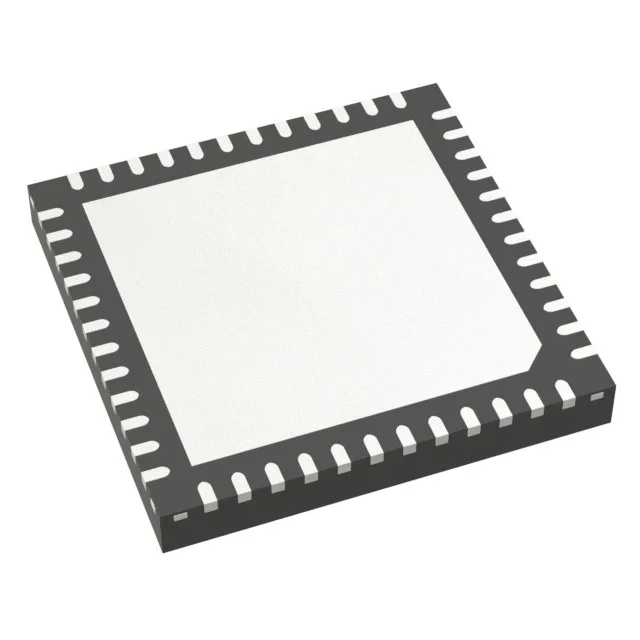
Package is a 48-lead UFQFN with an exposed pad (7x7 mm body). The exposed pad also serves as the main ground return for the core, so a solid solder joint there is critical. On a rework station, hot air at 300 °C with a fine nozzle works; just pre-bake the board if the moisture-sensitive level (MSL 3) floor life has been exceeded. The 48-UFQFPN footprint matches the STM32F0 Discovery board's layout, so you can prototype with a Nucleo-F091RC or similar and then drop this part onto the production board with minimal signal re-routing.
Analog peripherals — 13-channel ADC and dual DAC
Thirteen 12-bit ADC channels and two 12-bit DAC channels are on-chip. That is enough for a three-phase current-sense plus a couple of voltage monitors without adding external ADCs. The DACs are useful for generating analog setpoints or audio-level outputs.
That covers most industrial fieldbus and sensor interfaces without extra transceivers (except CAN, which still needs an external transceiver). The DMA engine offloads the Cortex-M0 during high-rate data transfers — useful when streaming ADC samples or shuttling UART packets without stalling the core. With 37 I/O lines in the 48-pin package, you get enough GPIO for a small keypad, LED indicators, and a parallel LCD interface if needed, though the pin count is tight for a full 16-bit parallel bus.
ST lists the STM32F098CCU6 as an active product. For dual-sourcing resilience, the STM32F098C8T6 (same core, 64 KB Flash, LQFP-48) is a pin-compatible drop-in if your firmware fits the smaller Flash; otherwise, the STM32F098CCU6 is the higher-density option in the same package.