48 MHz Cortex-M0 with 128 KB Flash — what fits in this envelope
This is the mid-density sweet spot in the STM32F0 line — enough Flash for a modest RTOS or bare-metal control loop, with the RAM to buffer sensor data or a small communications stack.
128 KB / 32 KB — sizing the firmware budget
128 KB of Flash (128K x 8) and 32 KB of RAM (32K x 8) define the boundary for what this chip can run. That Flash holds the application code, bootloader, and any constant lookup tables; 32 KB RAM is enough for a FreeRTOS heap plus a few large buffers, but a TCP/IP stack with multiple sockets will push against the ceiling. The 48 MHz Cortex-M0 core handles the arithmetic and control logic without a hardware FPU or DSP extension — bit-banging and PID loops are fine, but don't plan on FFTs or floating-point filtering without software emulation.
Connectivity and analog — CAN, 13-channel 12-bit ADC, dual DAC
The connectivity set covers CANbus, I²C, SPI, UART/USART, LIN, and IrDA — enough for an industrial sensor hub communicating over CANopen or Modbus RTU. DMA offloads the Cortex-M0 from moving ADC results to RAM, which matters when the core is busy with protocol parsing or control math. The POR (power-on reset) peripheral simplifies the power-up sequencing: no external supervisor IC needed as long as the supply ramp meets the datasheet requirement.
48-LQFP — layout and assembly notes
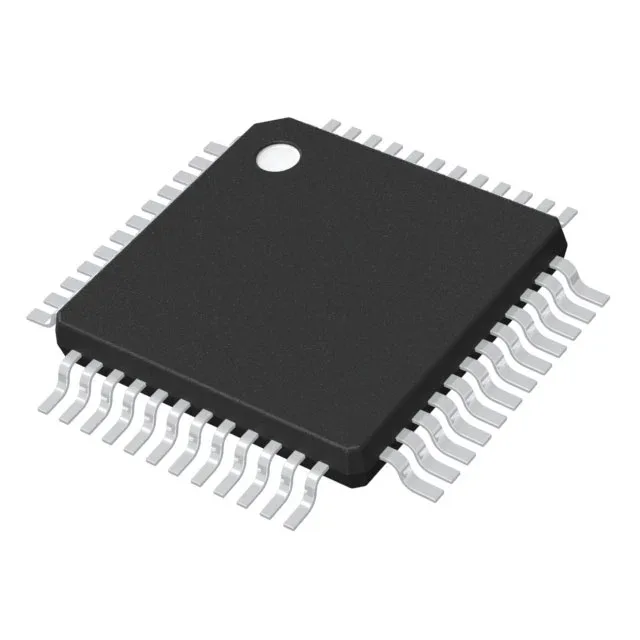
The 48-LQFP package (7x7 mm) is surface-mount only.
Lifecycle — active, no end-of-life watch
This is a current-production STM32F0 series part, safe to design into new builds and production ramps. No second-source alternate is recorded on this listing.