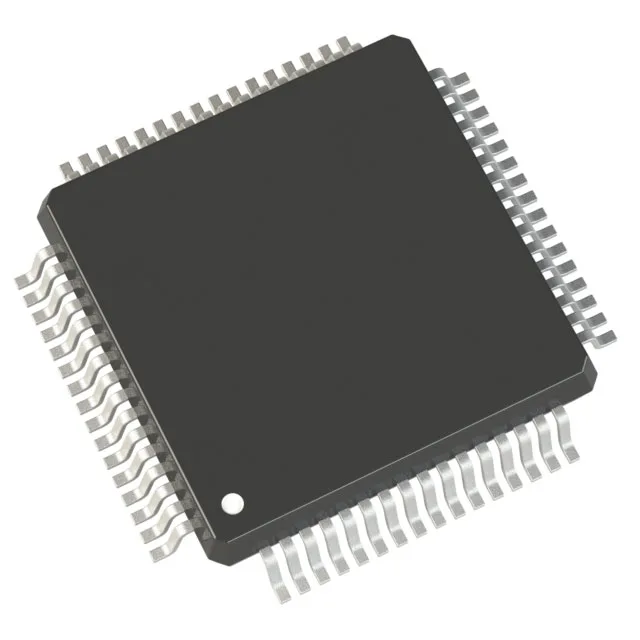
It is built for cost-sensitive embedded control applications — motor drives, sensor hubs, human-machine interfaces, and industrial fieldbus nodes — where the Cortex-M0 core delivers adequate throughput at a lower unit cost than M3/M4 parts. The 48 MHz clock is the practical ceiling for single-cycle multiply and branch-heavy control loops; above that the flash wait-state penalty erodes the gain, so the speed rating is a realistic throughput bound, not a marketing number.
On-chip peripherals include CANbus, USB (device/host with on-chip PHY), I²C, SPI, UART, and HDMI-CEC — covering the common industrial and consumer connectivity requirements in one package.
Data converters and analog integration
The 12-bit resolution is adequate for 0.1% measurement accuracy with proper reference and layout; the 19 input channels cover multi-sensor acquisition without external muxing. The internal oscillator trims to within 1% accuracy over temperature, enough for UART timing and most non-critical clocking, though a crystal is still advisable for CAN or USB operation where the bit-time tolerance is tighter.
Active lifecycle — no supply risk for new designs
The base product number STM32F072 covers a range of Flash and package options, so the die and test program are well-established.