128 KB of Flash is the mid-density sweet spot in the STM32F0 line: enough for a USB stack, a CANopen node, and a modest application layer without squeezing. The 16 KB SRAM (organized as 16K x 8) handles two 1 KB USB buffers plus a couple of moderate-size data arrays. If your application needs more than 16 KB of RAM for frame buffers or large lookup tables, step up to the STM32F072RBT6 with 128 KB SRAM — but for typical sensor hubs, motor-control UIs, or USB-to-serial bridges, this part leaves comfortable headroom.
There is no NRND notice, no last-time-buy window, and no announced end-of-life. The base product number STM32F072 covers a range of Flash and package options, so if you later need more memory or a different footprint, the migration path stays within the same family.
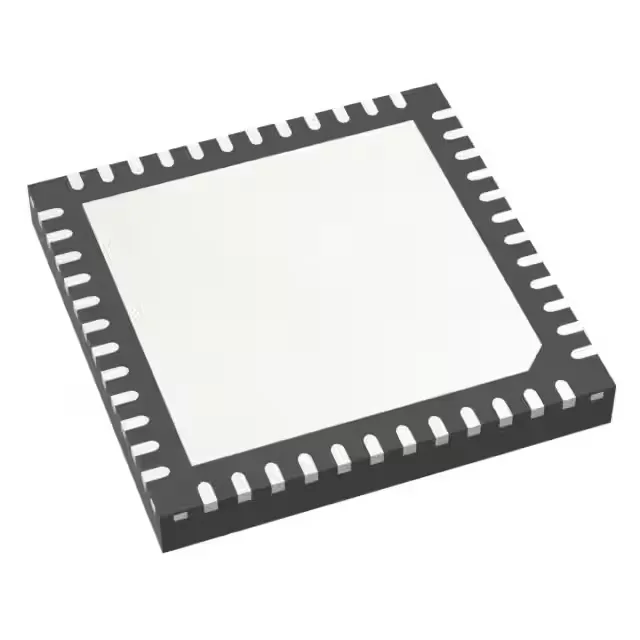
48-UFQFN exposed-pad package — layout and assembly notes
The pad is electrically connected to VSS, so the PCB footprint should mirror the 7x7 mm land pattern with a 4x4 array of 0.3 mm vias. MSL 3 out of the bag — if the moisture-barrier bag has been open longer than the floor-life window, bake at 125 °C for 48 hours before reflow. The tape-and-reel variant (TR suffix) feeds directly into a pick-and-place; the cut-tape option (CT) works for prototype runs.
Peripheral set — USB, CAN, and analog
This MCU includes USB 2.0 full-speed with an integrated PHY, so no external transceiver is needed for device-mode connections. The CANbus interface targets industrial automation and automotive aftermarket nodes. On the analog side, there are ten 12-bit ADC channels and two 12-bit DAC outputs — enough for a single-phase motor current sense plus a setpoint voltage. The DMA controller offloads the Cortex-M0 for USB and ADC transfers, and the I²S interface handles audio or serial data streaming.