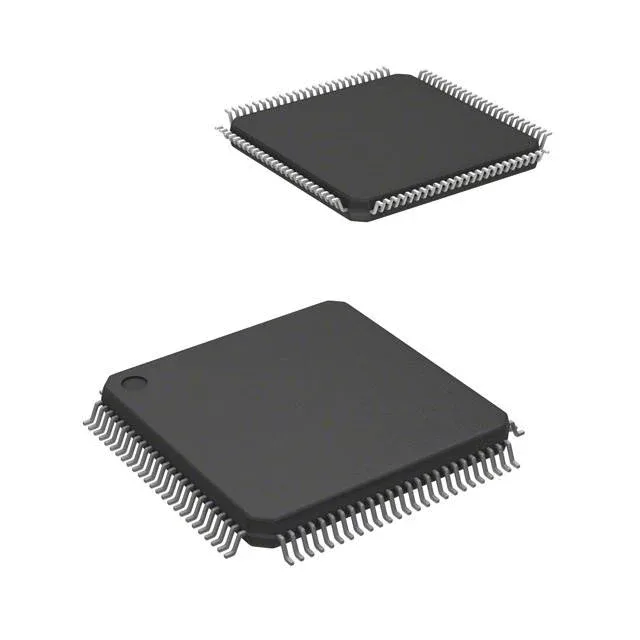
ARM Cortex-M0 MCU for cost-sensitive control and sensor-fusion designs
It targets embedded control applications where peripheral integration and low pin-count overhead matter more than raw DSP throughput — think motor-control feedback loops, sensor hubs aggregating I2C and SPI data streams, and human-machine interfaces with local display and keypad handling. The 87 available I/O in a 100-LQFP package give ample headroom for parallel LCD buses, multiple encoder inputs, and banked GPIO for relay or solenoid drivers.
Supply rail and temperature grade — what they mean for deployment
At the low end, the internal POR and brown-out reset keep the core from corrupting Flash during slow ramp or sag. No AEC-Q100 grade is listed, so it stays out of safety-rated automotive domains without additional screening.
On-chip analog and serial connectivity — one-chip sensor front-end
The connectivity block includes I2C, SPI, UART/USART, LIN, IrDA, and HDMI-CEC — covering the usual industrial and consumer serial buses. DMA on the peripherals means the CPU can service control loops while the ADC results and UART buffers transfer in the background.
Package and footprint — 100-LQFP layout notes
The 100-LQFP (14x14 mm body, 0.5 mm pitch) is a common footprint shared across the STM32F0 100-pin variants. Decouple the VDD/VSS pairs with 100 nF ceramics as close to each pin pair as the layout allows; a single 4.7 µF bulk cap per supply rail handles low-frequency transients.
For dual-sourcing resilience, the pin-compatible STM32F072V8T6 (with USB 2.0 device peripheral) drops into the same footprint and supply rail, though the firmware must account for the additional USB register block if that peripheral is enabled.