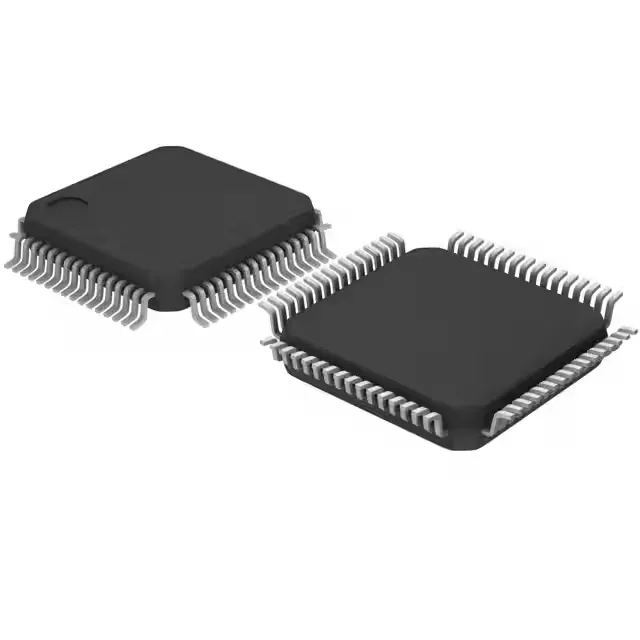
48 MHz Cortex-M0 — enough throughput for sensor fusion and motor control loops
The STM32F051R8T7TR: The core runs at 48 MHz on the ARM Cortex-M0 architecture, which delivers the deterministic interrupt response and low-power profile that the STM32F0 series is known for. At this clock speed, the part handles 2-3 kHz current-control loops in a brushless DC motor drive, or processes 10+ analog sensor channels through the 19-input 12-bit ADC without needing an external multiplexer. The 8 KB SRAM leaves room for a modest data buffer — enough for a 4 KB OTA staging area plus stack and heap, assuming the application does not run a full RTOS with large task stacks.
Industrial temperature grade and 55 I/O in a 64-LQFP
The 64-LQFP (10x10 mm) package breaks out 55 general-purpose I/O, which is a dense pin count for the footprint and allows routing of parallel LCD data buses or multiple UART/SPI interfaces without signal sharing. Supply voltage spans 2V to 3.6V, so the part runs directly from a 3.3V rail or a 2.5V battery supply.
Peripherals set — DMA, PWM, and analog conversion on one die
The integrated DMA engine offloads the Cortex-M0 core during ADC conversions and serial data transfers, which matters for real-time control where every cycle counts. The PWM timer channels support complementary outputs with dead-time insertion, making this part suitable for three-phase inverter control in power tools or small pumps. The 19-channel 12-bit ADC and single 12-bit DAC cover multi-sensor acquisition and analog output generation without external converters. The PVD (programmable voltage detector) and POR (power-on reset) blocks simplify the power-supervision BOM — no external reset IC needed for most designs.
Package traceability and surface-mount handling
The 64-LQFP package is MSL 3 — the moisture-sensitive floor life is 168 hours out of the sealed bag. If the reel has been exposed beyond that window, a 24-hour bake at 125°C before reflow is the standard recovery step. The laser-etched marking on the top of the package carries the date code and lot trace code; a mismatch between the date code and the reel label is the first red flag for gray-market material.