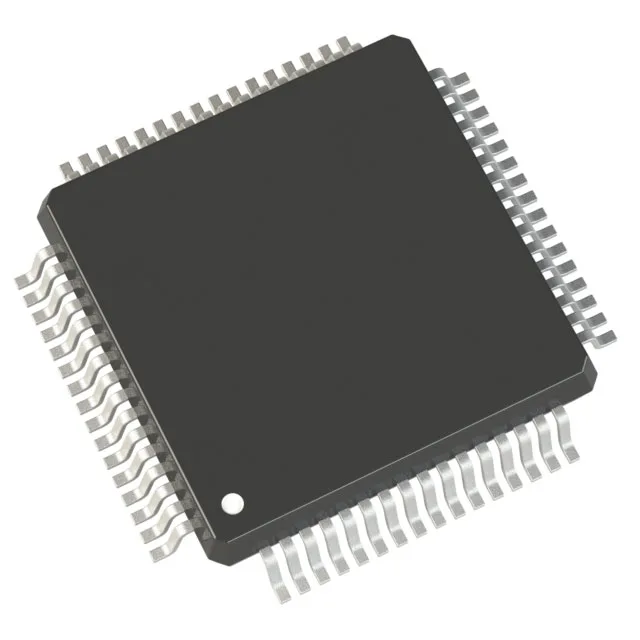
Entry-level 32-bit MCU for cost-sensitive control applications
Typical applications include industrial control, sensor interfaces, motor control, and consumer electronics where a low-cost, low-power 32-bit core is required.
48 MHz Cortex-M0 — what the core speed means for your timing budget
The 48 MHz clock rate from the ARM Cortex-M0 core is a single-cycle execution engine with a three-stage pipeline. For a typical control loop — reading an ADC sample, processing a PID term, updating a PWM duty cycle — the 48 MHz throughput leaves enough margin to run the loop at 10 kHz or higher without relying on DMA offloading. If your application requires tighter timing, note that the flash wait state needs to be configured for zero wait states up to 48 MHz; above that the part does not go, so this is the full rated speed.
That is enough for a sensor hub running a Modbus RTU stack, a brushless DC motor controller with Hall-sensor commutation, or a simple HMI with a character LCD. If your application needs over-the-air update staging or a larger protocol stack, the pin-compatible STM32F051R8T6 doubles the Flash to 64 KB without changing the PCB footprint.
The internal POR and brown-out reset circuitry keeps the core safe during power-up and sag events, so no external supervisor is needed for most designs.
Analog integration — 19-channel ADC and 12-bit DAC
The on-chip 19-channel 12-bit ADC and single 12-bit DAC reduce external analog IC count for mixed-signal applications. The ADC can sample up to 1 Msps with hardware oversampling, enough for current-sense feedback in a motor drive or multi-channel temperature monitoring. The DAC output can drive an analog setpoint or serve as a reference for an external comparator.
For dual-sourcing resilience, the STM32F051R8T6 (64 KB Flash variant) is pin-compatible and can be qualified as a drop-in replacement with a firmware update to use the extra memory.