At 48 MHz the Cortex-M0 executes most single-cycle instructions, giving you a 20.8 ns instruction cycle. That is fast enough for 10 kHz current loops or 100 kHz sensor readouts with headroom for protocol overhead. The flash wait state needs to be set to 1 when running above 24 MHz, or the core hard-faults on the first branch — a common bring-up trap.
16 KB of Flash is tight for a full RTOS stack; bare-metal or a lightweight scheduler fits comfortably. The 8 KB RAM handles a couple of moderate-size buffers — plan for a 2 KB comms buffer and 1 KB for stack, leaving about 5 KB for application data. If your firmware needs OTA or a large lookup table, step up to the 32 KB or 64 KB Flash variants in the same package.
Package and thermal pad — layout notes
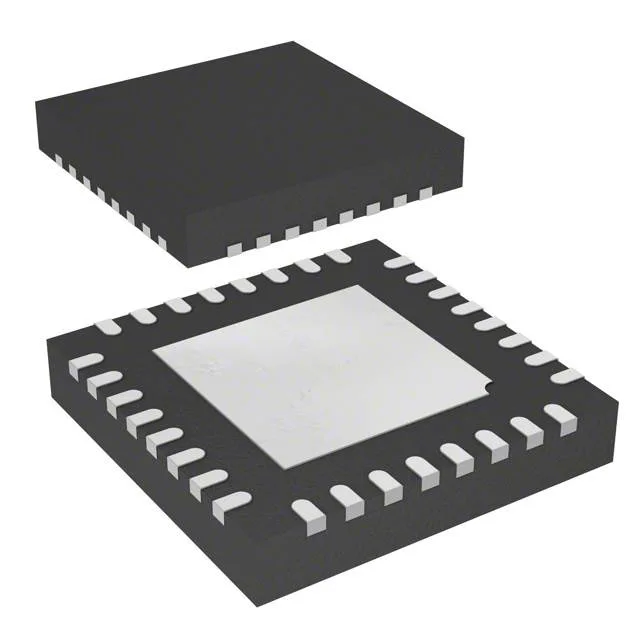
The 32-UFQFPN (5x5 mm) with exposed pad is a dense, low-profile package suited for space-constrained PCBs. The pad is also the only thermal path; the plastic body does little to dissipate heat.
It is not qualified for under-hood automotive (no AEC-Q100) or extended 105°C/125°C environments. For those, look at the STM32F0 automotive-grade siblings.