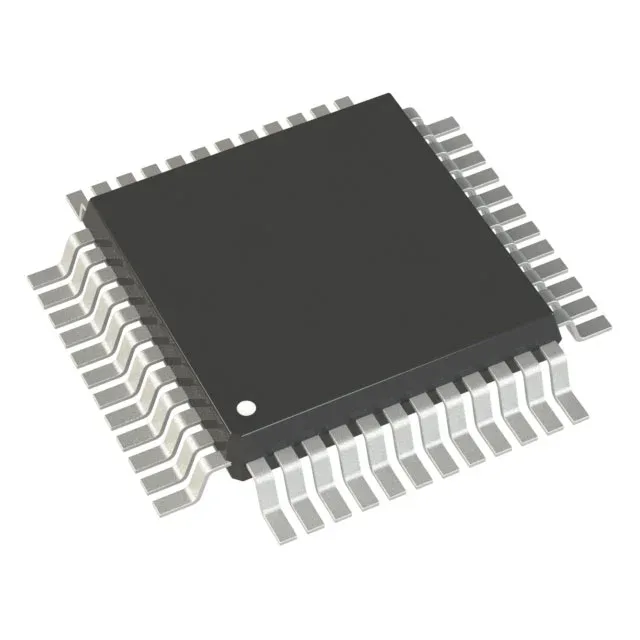
What this Cortex-M0 MCU brings to a BOM
At 48 MHz the Cortex-M0 delivers enough compute for polling loops, timer-based PWM generation, and moderate data processing. The flash wait-state penalty at this clock is minimal — the core can sustain single-cycle access from Flash at 48 MHz with the prefetch buffer enabled, keeping interrupt latency predictable. For comparison, the STM32L151CBU6A runs at 32 MHz, so this part has a 50% clock advantage for tasks that don't need the series' low-power features.
Memory budget — 16 KB Flash, 8 KB RAM
That's enough for a bootloader plus a modest application — think a CAN node, a brushless-DC commutation loop, or a serial-to-I²C bridge. If your code footprint exceeds 12 KB or your RAM needs push past 6 KB (leaving headroom for stack and DMA buffers), you'll want to step up to a higher-density STM32F0 variant like the STM32F051K6 or STM32F051K8.
It is not qualified for automotive under-hood or extended-temperature applications (125°C).