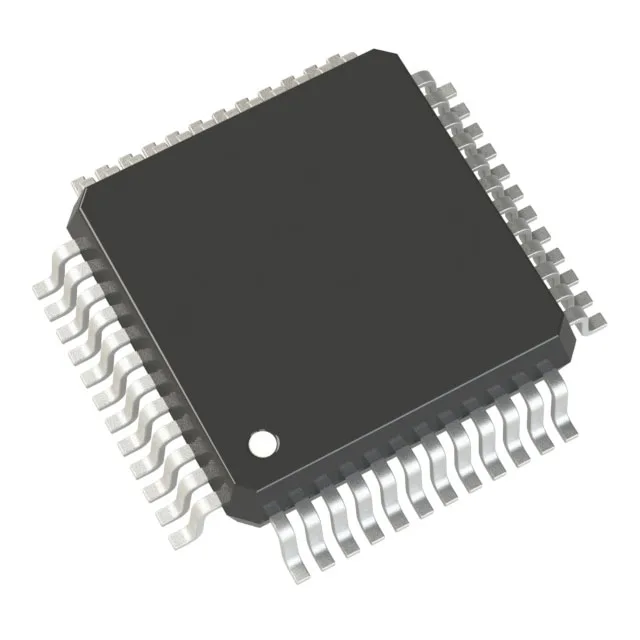
The 48 MHz core speed, combined with the single-cycle multiply and tightly coupled DMA, keeps interrupt latency low enough for 10–20 kHz current loops without external RAM. The 48-LQFP package (7x7 mm) exposes 39 I/Os, enough to handle a three-phase inverter gate-drive interface plus Hall/encoder inputs and a UART debug link.
The 105°C ceiling gives headroom when the part is sited near a power stage or in a sealed enclosure with limited airflow. If your design lives in a climate-controlled lab or office appliance, the commercial-grade sibling (0°C to 70°C) is a cost-down option — but for any environment that sees seasonal extremes or self-heating, the T7 suffix is the right call.
Analog integration — reducing the external BOM
The on-chip 13-channel 12-bit ADC and single 12-bit DAC cover the typical analog interface for a current-sense shunt, thermistor input, and a set-point voltage output. For a three-phase motor drive, the 13 ADC channels can sample all three phase currents plus DC-link voltage and a temperature sensor without an external multiplexer. The internal oscillator (rated ±1% accuracy over temp) eliminates the external crystal for UART and basic timing, though a precision clock is still needed for CAN or USB — neither of which this part supports directly.
Peripherals and connectivity — what is on the bus
The I²C and SPI interfaces run at standard speeds and share pins with the GPIO bank, so pin-mux planning is straightforward. The HDMI-CEC block is a niche addition for consumer AV equipment; for industrial designs it is simply unused silicon. DMA, PWM, and a windowed watchdog are present, which covers the basic control-loop housekeeping without an external supervisor IC.
The base product number STM32F051 covers multiple density and package variants, so if a future board spin needs more Flash or a different pin count, the migration stays within the same family.