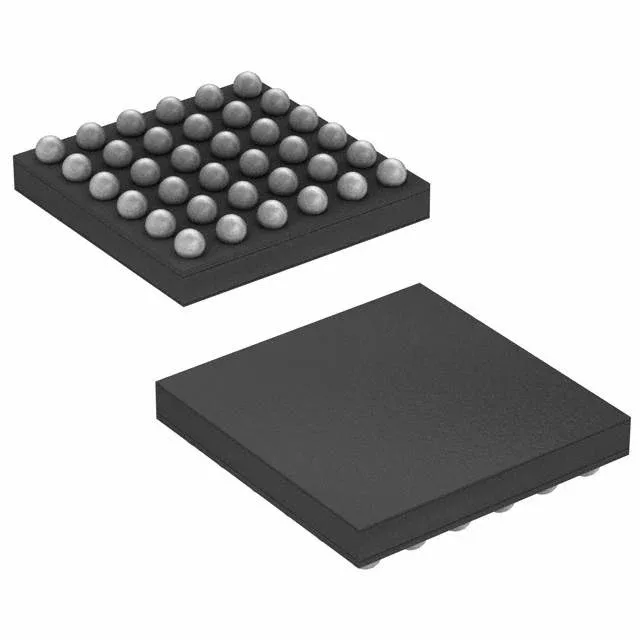
48 MHz Cortex-M0 in a 1.65V WLCSP — the low-power, small-footprint MCU for space-constrained battery gear
Its distinguishing feature is the supply range: 1.65V to 1.95V, which lets it run directly from a single Li-ion cell or a 1.8V regulated rail without an external boost converter. The 36-bump WLCSP package (36-UFBGA, WLCSP) keeps the board footprint minimal — critical for wearable sensors, hearing aids, or compact IoT modules. The 13-channel 12-bit ADC and internal oscillator reduce external BOM count.
1.65V rail — what the low supply buys you
Most STM32F0 parts need 2.0V to 3.6V. The STM32F048T6Y6TR's 1.65V to 1.95V range is a deliberate low-voltage variant. In a single-cell Li-ion design (3.7V nominal, 2.7V cut-off) you'd normally need a buck regulator. Here, a small LDO from the battery to 1.8V feeds the MCU directly — saves a switching regulator inductor and capacitor. For 1.8V-logic systems (many MEMS sensors, low-power RF chips), the MCU sits on the same rail as the peripherals, no level shifters needed.
WLCSP footprint — layout and rework realities
The 36-bump WLCSP (36-UFBGA, WLCSP) is a direct-attach package with 0.4 mm or 0.5 mm pitch depending on the variant — the supplier device package is 36-WLCSP. No exposed pad, no corner balls to route out. The board needs micro-vias or via-in-pad if the escape routing is tight. For hand-assembly prototypes, consider a breakout board or a socket — the WLCSP bumps are not probe-friendly.
32 KB Flash, 6K x 8 RAM — memory headroom for typical firmware
32 KB Flash and 6 KB SRAM place this MCU in the entry-level tier. Enough for a sensor hub reading an IMU over I²C, logging data to a serial Flash via SPI, and running a USB HID or CDC class. The 6 KB RAM handles a small RTOS (FreeRTOS tick and a few tasks) plus a 1 KB buffer for USB or audio I²S streaming.
STMicroelectronics lists the STM32F048T6Y6TR as Active. If you need a second-source option, the same base product number (STM32F048) in a different package (LQFP, UFQFPN) is pin-compatible at the die level — the WLCSP variant is the smallest footprint, so swapping to a QFN means a PCB layout change.