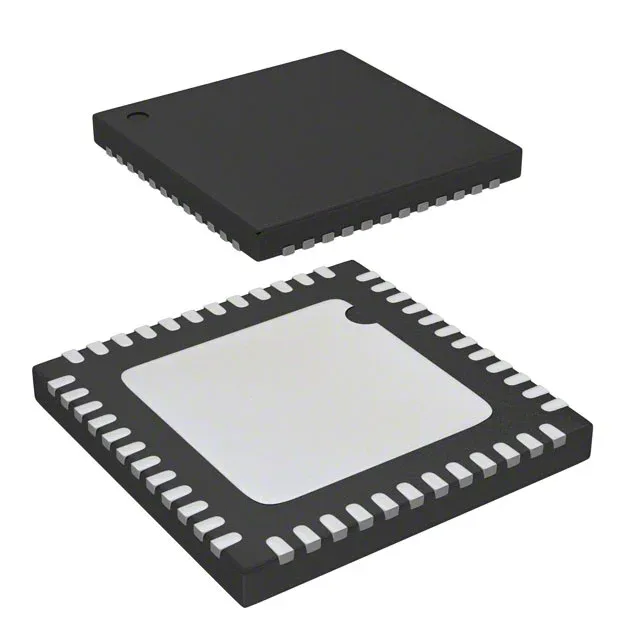
48 MHz Cortex-M0 with USB and CAN in a 7x7 mm footprint
It targets cost-sensitive embedded control applications where USB device connectivity or CAN bus networking is required — think sensor nodes, compact motor drives, and human-machine interfaces that need a small physical footprint. The 48-UFQFPN package (7x7 mm) with an exposed pad keeps the board area tight while offering 38 I/O lines, including a 13-channel 12-bit ADC for analog sensor inputs.
Flash and RAM sizing for the firmware budget
The Flash is enough for a USB stack, a CANopen node, or a small RTOS kernel plus application code, but you will need to watch the linker map — a full-featured bootloader plus USB CDC class driver can consume half the Flash. The 6 KB SRAM handles a couple of moderate-size buffers; if your application needs large frame buffers or a deep FIFO, step up to the 16 KB SRAM variants in the same series. If you do use the internal RC, budget for ±1% accuracy across temperature — adequate for UART timing but marginal for full-speed USB without clock recovery.
Connectivity set: USB device, CAN 2.0B, and legacy serial
The STM32F042C6U6 includes a USB 2.0 device controller (full-speed, 12 Mbps) and a CAN 2.0B interface, which is unusual in the sub-32 KB Flash Cortex-M0 space. This makes it a strong fit for USB-to-CAN gateways, industrial sensor hubs, and battery-powered peripherals that need to talk to both a host PC and a fieldbus. The SPI, I2C, and UART interfaces round out the connectivity for local sensors and actuators. The DMA controller offloads the core for peripheral transfers — useful for keeping the USB or CAN pipes fed without stalling the CPU on each byte.
This is a mainstream part in the STM32F0 portfolio, so supply through standard distribution is stable.