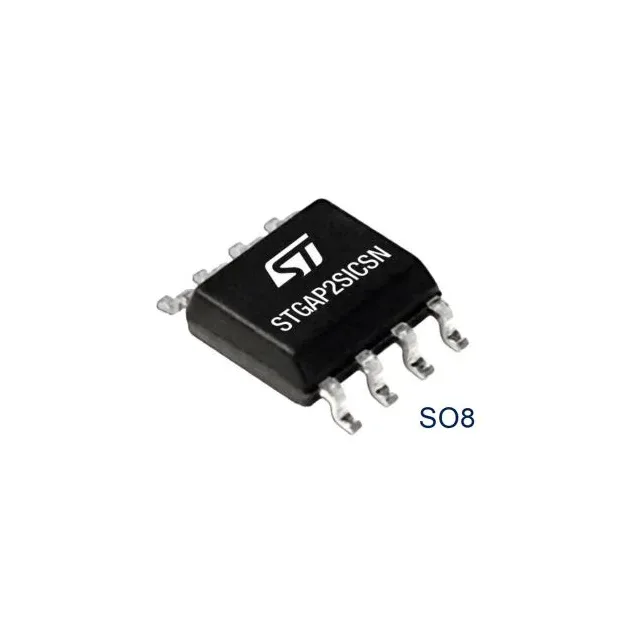
The STMicroelectronics STGAP2SICSNTR is a single-channel isolated gate driver built around capacitive coupling technology, delivering 4000Vrms of galvanic isolation between the input logic and the output power stage. It is designed to drive silicon carbide (SiC) MOSFETs and high-power IGBTs in applications where fast switching edges and high common-mode transient immunity are non-negotiable.
The 4000Vrms isolation rating is the reinforced-safety barrier between the controller-side logic and the high-voltage power stage. In a 600V or 1200V bus system, that isolation voltage gives enough margin for basic insulation per IEC 60747-17. The 100V/ns minimum CMTI is the real gate-driver stress test: when the low-side switch turns on and the switch node slews from the negative rail to the positive rail in a few nanoseconds, the capacitive coupling inside the driver must reject that common-mode transient without corrupting the output state. If the CMTI is too low, the output can glitch, shoot-through the half-bridge, and let the magic smoke out. At 100V/ns, this part is specced for the edge rates you get with SiC MOSFETs switching at 50-80V/ns, not just slower IGBTs.
Output drive: 4A peak, 30ns edges, and supply range
The output stage delivers 4A peak source and 4A peak sink current, which is enough to drive the gate charge of a typical SiC MOSFET module (e.g., 50-100 nC total gate charge) through the Miller plateau in under 100ns. The output supply range of 16.4V to 26V covers the typical +18V to +20V gate drive for SiC devices and the +15V commonly used for IGBTs. The maximum propagation delay of 90ns (both low-to-high and high-to-low) is symmetric, and the 20ns maximum pulse-width distortion keeps the duty cycle accurate in PWM schemes running at 20-100 kHz.
The 8-SO footprint is common across many isolated gate drivers, which simplifies second-sourcing or layout reuse. The UL approval agency listing means the isolation rating has been certified to UL 1577, a requirement for many industrial and commercial power supplies sold into North America.
For BOM planning, that means no forced redesign or last-time-buy scramble in the near term. It is also ROHS3 compliant, which clears the restriction-of-hazardous-substances gate for EU and global markets.