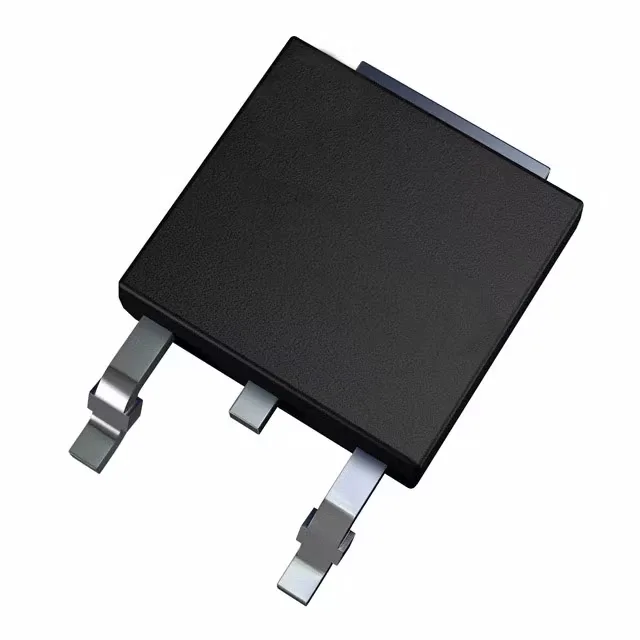
DPAK footprint and thermal story
The STD45NF75T4 comes in the DPAK (TO-252) surface-mount package — a three-lead tabbed footprint that uses the board copper as the primary heatsink. The exposed tab is the drain, so the PCB pad area under the tab sets the junction-to-ambient thermal resistance; a 1-inch² copper pour on a 2-oz board typically keeps the tab temperature within 30 °C of ambient at the rated 125 W dissipation (Tc).
A gate driver sourcing 1 A charges the gate in roughly 80 ns, but the practical switching edge is slower because the Miller plateau extends the rise time. Input capacitance (Ciss) is 1760 pF at 25 V drain-source. This loads the driver output at the start of the switching transition; a 10 Ω series gate resistor slows the edge enough to control ringing without extending the switching loss significantly.
Temperature grade and operating margin
The junction temperature range is -55 °C to 175 °C — the full industrial temperature band plus margin for self-heating. At 40 A continuous, the junction rises above the case temperature by the product of Rds(on) and the square of the current, times the thermal resistance junction-to-case. At 125 °C junction, Rds(on) roughly doubles from the 25 °C value, so the available continuous current derates.