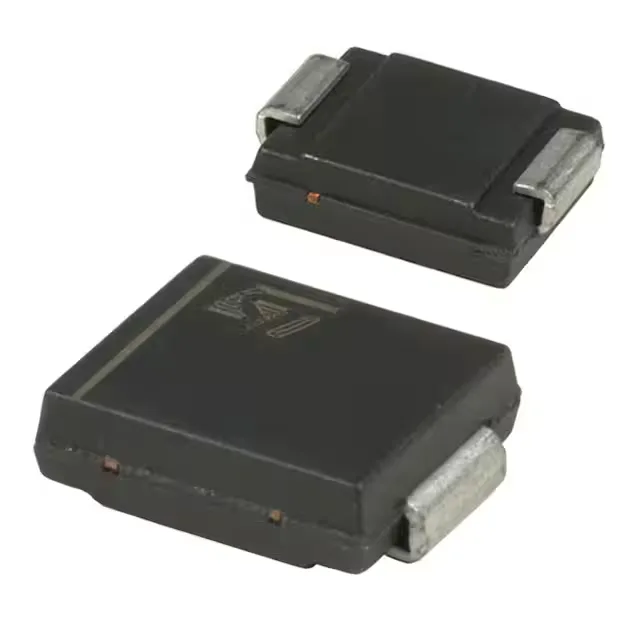
Transient protection for a 33V rail
It handles 1500W peak pulse power per the 10/1000µs waveform, with a clamping voltage of 69.7V at the peak pulse current of 143A (8/20µs). The 36.7V minimum breakdown voltage defines the avalanche threshold — the part starts conducting here, so the protected rail must stay below this level during normal operation. This is a general-purpose transient suppressor for power supplies, industrial controls, and telecom equipment where a single 33V rail needs surge protection.
Clamping voltage and rail coordination
The 69.7V maximum clamping voltage at Ipp is the voltage the downstream circuit sees during a surge event. If the protected component's absolute maximum rating is, say, 70V, this part leaves only 0.3V of margin — borderline. For a 33V rail, typical downstream ICs are rated 40V to 60V, so the 69.7V clamp is acceptable for most designs, but worth checking against the specific load's breakdown.
Housed in the DO-214AB (SMC) package, this is a surface-mount device with a standard footprint shared across the SMCJ family.