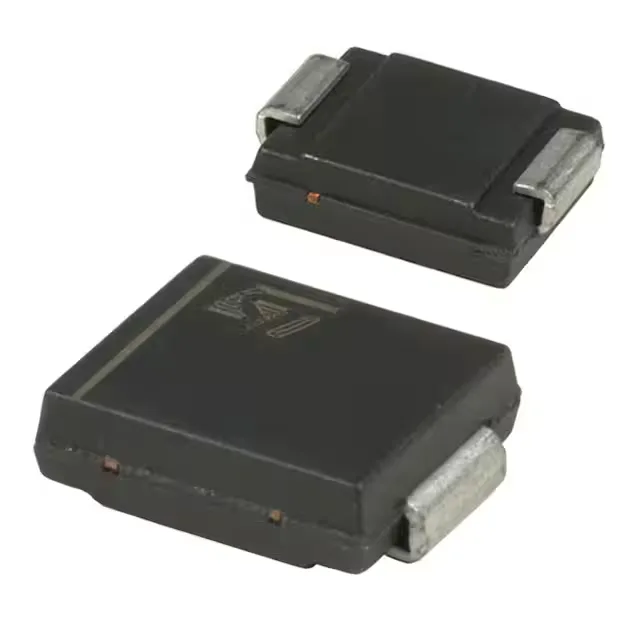
What this TVS does and why it matters
The STMicroelectronics SMCJ24CA-TR is a bidirectional TVS diode from the TRANSIL™ SMCJ series, designed to clamp transient overvoltages on a 24V rail. Its 1500W peak pulse power rating (10/1000µs waveform) handles substantial surge energy, while the 50V clamping voltage at 200A (8/20µs) limits the let-through voltage to a level that protects downstream ICs. The bidirectional configuration means a single device protects both positive and negative transients — useful for AC-coupled lines or symmetrical signal pairs where polarity isn't fixed.
1500W peak pulse power — what it buys you
The 1500W rating (10/1000µs) is the standard telecom surge test level for secondary protection in 24V systems. It means this part can absorb a single 1ms-wide pulse up to 1500W without failing — enough for most industrial and automotive transient events like load dump or inductive kickback. For repetitive surges, derate per the pulse derating curve; the junction temperature limit of 150°C is the hard ceiling.
Bidirectional vs. unidirectional — picking the right one
The 'CA' in SMCJ24CA-TR signals bidirectional; the single-direction variant is SMCJ24A-TR. Bidirectional clamps symmetrically at ±50V, making it the choice for AC signals, RS-485 transceivers, or any line where the polarity isn't ground-referenced. Unidirectional gives a lower clamping voltage for positive-going spikes on a DC rail, but requires two devices for bipolar protection. For a 24V DC bus with a known ground reference, the unidirectional version may give tighter protection; for general-purpose board-level transient suppression where you don't want to think about polarity, the bidirectional part is the simpler call.
It's larger than the SMA/SMB siblings, which means better thermal dissipation for the 1500W rating. The cathode band is marked for unidirectional parts; on the bidirectional version, the band is absent or both ends are marked — verify orientation with the datasheet marking diagram.
That means it's suitable for outdoor telecom cabinets, engine bay electronics, and downhole tools where the ambient can exceed 125°C. The 150°C junction limit also provides headroom for self-heating during repetitive surge events — the thermal impedance of the SMC package is low enough that a single 1500W pulse raises the junction about 100°C, so at 25°C ambient you're still inside the limit.
For dual-sourcing resilience, the SMCJ24CA-TR is pin-compatible with other manufacturers' SMCJ24CA devices — the DO-214AB footprint and electrical specs follow the industry-standard JEDEC outline, so cross-sourcing is straightforward.