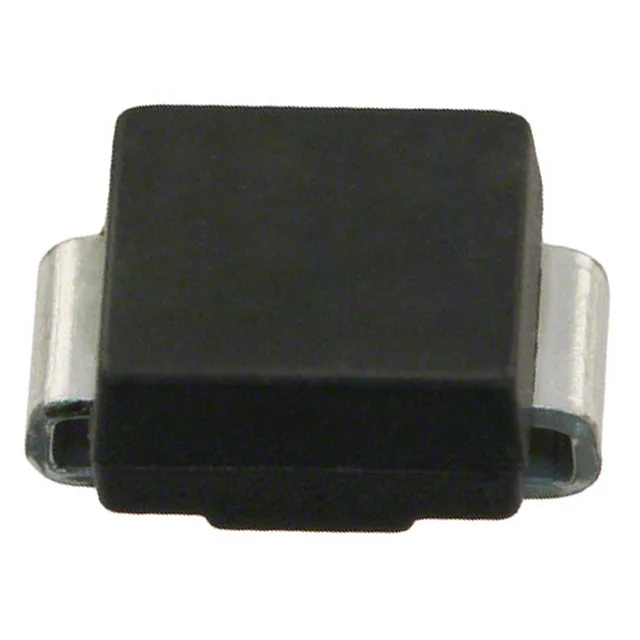
53.2V breakdown — where it triggers and why that matters
The SM6T56CA is a bidirectional TRANSIL™ TVS diode from STMicroelectronics, part of the SM6T series. Its 53.2V minimum breakdown voltage defines the point where the device starts clamping a transient. For a 48V nominal rail — common in telecom and industrial power — this breakdown sits comfortably above the steady-state voltage but triggers well before most downstream components hit their absolute maximum rating.
Bidirectional — one device for both polarities
With a single bidirectional channel, the SM6T56CA clamps positive and negative transients symmetrically. That means one component protects a signal line against both overvoltage and undervoltage spikes, which is useful on AC-coupled data lines, RS-485 pairs, or dual-supply analog inputs. No need to back-to-back two unidirectional diodes — the BOM stays lean.
600W peak pulse — sizing the surge protection
Rated at 600W peak pulse power for the 10/1000µs waveform, this device handles the energy from a typical IEC 61000-4-5 surge on a 48V telecom line or a 24V industrial bus. If your downstream silicon is rated for 120V absolute maximum, you have 20V of margin — enough for most secondary-protection scenarios.
Temperature range and package — design-in notes
No power line protection means this is a signal-line or low-power rail device, not a mains-side suppressor.