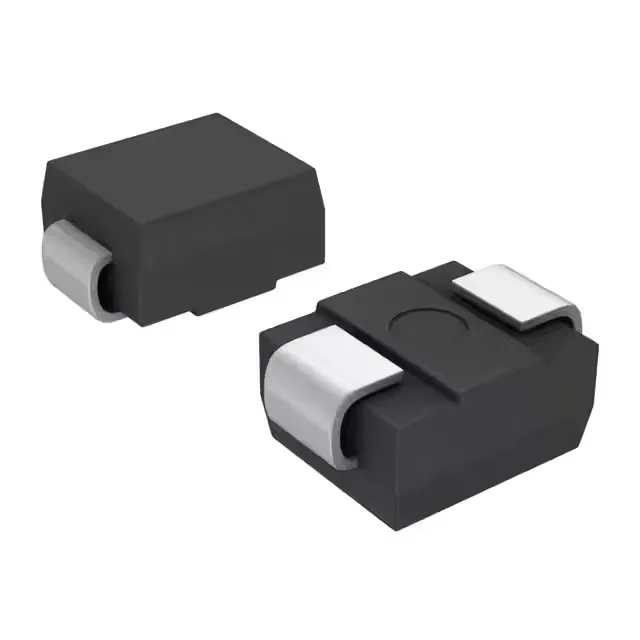
It is designed to protect a 14.1 V DC rail — typical of an automotive 12 V system — from transients up to 29 V clamping, with a peak pulse current capability of 136 A for an 8/20 µs waveform. The AEC-Q101 qualification and -55°C to 150°C operating junction temperature range suit it for under-hood and chassis-domain deployment where voltage spikes from load dump, alternator field decay, or inductive switching are a given.
Clamping voltage and standoff — sizing the protection margin
The reverse standoff voltage of 14.1 V means the diode stays off under normal battery voltage (up to ~14 V in a charged system). That 29 V ceiling is the number the downstream circuitry must survive — the designer checks the absolute-maximum rating of the ECU's input capacitors, the DC-DC converter's input range, and the microcontroller's VDD pin against this figure. A 600 W rating (10/1000 µs waveform) gives the headroom for repetitive load-dump events common in heavy truck and agricultural equipment applications.
AEC-Q101 and the SM6TY series — what the suffix means
The 'AY' suffix on the SM6T16V5AY designates the automotive-grade variant of the SM6T family, with full AEC-Q101 qualification and production-part-approval process (PPAP) support. The base part SM6T16V5 is the commercial-grade sibling, identical in electrical performance but lacking the extended temperature cycling and high-temperature reverse-bias (HTRB) testing required for automotive tier-1 submission. For a BOM destined for a passenger-vehicle ECU or a commercial-vehicle telematic module, the 'AY' suffix is the correct call — the commercial part cannot be substituted without requalification.
Package and footprint — DO-214AA (SMB)
The SMB (DO-214AA) package is a JEDEC-standard surface-mount outline shared with many 600 W TVS diodes from STMicroelectronics, Littelfuse, and onsemi. The solder pad footprint is common across suppliers, which simplifies second-source qualification.