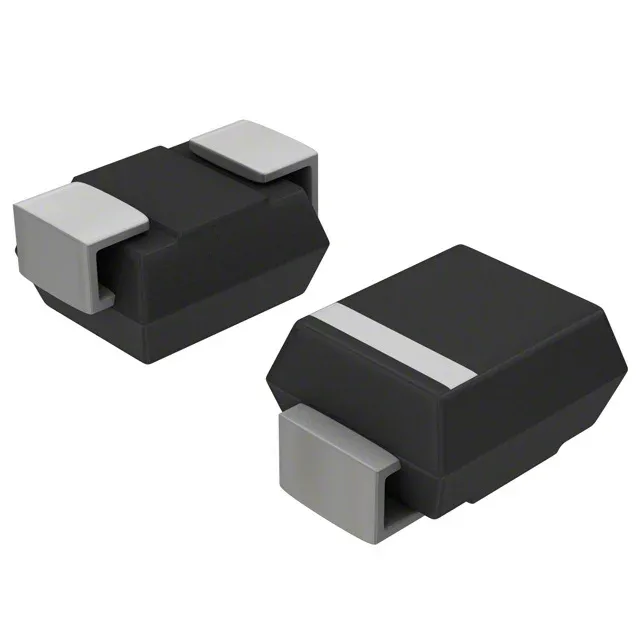
Automotive-grade TVS for 30V rail protection
The single bidirectional channel clamps both positive and negative surges, so a single device covers a differential pair or an AC-coupled signal line where two unidirectional parts would otherwise be needed.
The reverse standoff voltage is 30V, meaning the part does not conduct appreciably below that level — your 30V supply rail sees no leakage under normal operation. The minimum breakdown voltage is 33.3V, so the part starts to avalanche at roughly 10% above the rail, giving a clean trigger threshold. When the surge hits, the clamping voltage is held to 64.3V maximum at the peak pulse current of 36A (8/20µs waveform). That 64.3V clamp is what the downstream circuitry must survive; if your 30V-rated ICs have a 36V absolute maximum, this TVS provides a 28V margin between the clamp and the IC limit.
Peak pulse power and temperature range
Rated at 400W peak pulse power for the standard 10/1000µs waveform, the SM4T35CAY can absorb a substantial single-pulse surge — think load-dump or inductive kickback on an automotive 12V or 24V bus. At 150°C junction, the leakage and breakdown voltage shift slightly, but the part remains functional; the AEC-Q101 qualification includes high-temperature reverse bias testing to confirm that.
Housed in the SMA package, the SM4T35CAY is a surface-mount device with a standard two-pad footprint. The SMA package is widely used for TVS diodes in automotive and industrial designs; its small body saves board space compared to the larger SMC package.