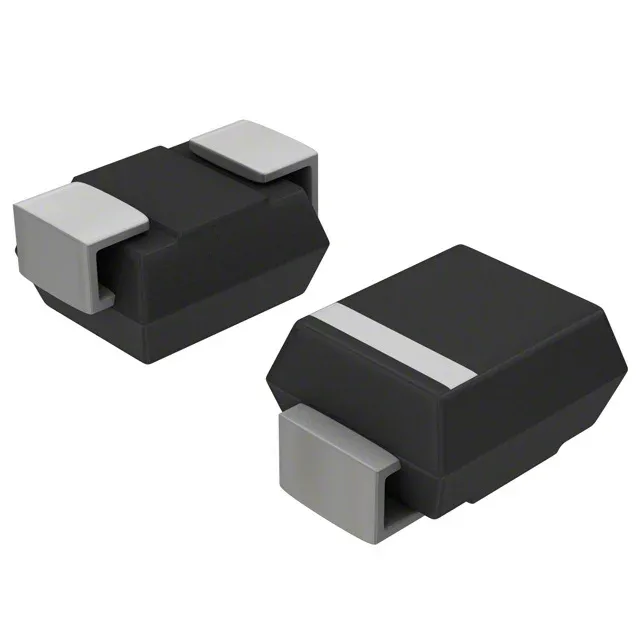
What the 26V standoff and 53.5V clamp mean for a 24V automotive bus
Its 26V reverse standoff voltage sits just above a nominal 24V supply rail, so the diode stays out of conduction under normal operating conditions. When a transient exceeds the 28.9V minimum breakdown threshold, the device clamps the surge to a maximum of 53.5V at the rated peak pulse current of 43A (8/20 µs waveform). That clamping voltage is the number to check against the downstream IC's absolute-maximum input rating—if the ECU's regulator or transceiver can survive 53.5V for the pulse duration, this part provides adequate protection.
400W peak pulse power—what it handles and what it doesn't
For an automotive 24V system, this covers most inductive-load dump and ISO 7637-2 pulse 5a scenarios, but a direct lightning strike or a long-duration alternator load dump may exceed the device's safe operating area. The 43A peak pulse current at 8/20 µs gives a fast-rise surge benchmark for ESD and short-circuit transients. Power line protection is explicitly not supported, so this part should be used on signal or low-power supply lines, not on the main battery or alternator bus.
AEC-Q101 and the SMA package: what the qualification buys you
AEC-Q101 qualification is the automotive-grade baseline for discrete semiconductors. It means the SM4T30AY has passed the stress tests (HTRB, H3TRB, TC, etc.) required for use in under-hood and chassis-domain electronics, and the supplier can provide PPAP documentation on request.