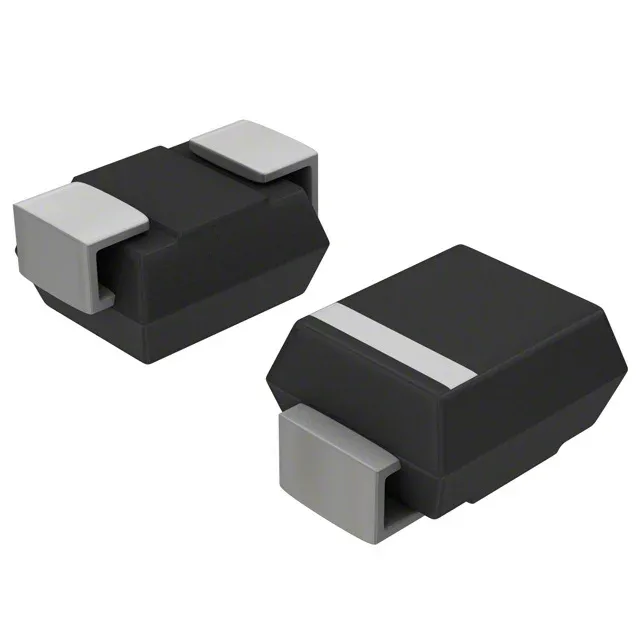
400 W bidirectional TVS for 20 V automotive rails
The STMicroelectronics SM4T23CAY is a bidirectional Zener-based transient voltage suppressor from the TRANSIL™ family, purpose-built for automotive electronics. The part clamps at 42.8 V maximum on a 54 A peak pulse current (8/20 µs waveform), which keeps the downstream silicon inside its safe operating area during a 400 W surge event. The reverse standoff voltage is 20 V, so it sits across a nominal 12 V rail without conducting leakage, but begins to break down at 22.2 V minimum — a tight tolerance that leaves margin for the regulator's output.
The 20 V reverse standoff voltage is the DC or peak-AC voltage the part can withstand without conducting appreciable current. Below that, it looks like an open circuit. The minimum breakdown voltage of 22.2 V is where avalanche conduction starts — the point at which the TVS begins to shunt current. For a 12 V automotive rail that can transiently rise to 30 V or more during a load dump, the 42.8 V clamp keeps the downstream 40 V-rated MOSFETs or 36 V-rated ICs out of avalanche. The 400 W peak pulse power rating (8/20 µs) is the energy-handling capability for a single pulse; repetitive events need derating per the datasheet's pulse-derating curve.
Housed in a DO-214AC (SMA) package, the SM4T23CAY is a surface-mount device with a small footprint — roughly 4.5 mm by 2.8 mm body. The operating junction temperature range is -55°C to 150°C, covering the full automotive temperature envelope from cold-crank at -40°C to under-hood ambient near 125°C. No power line protection (the part is unidirectional in function, but bidirectional in pinout — it clamps both polarities equally).
It is AEC-Q101 qualified, which means the part has been through the full automotive qualification flow — high-temperature reverse bias, temperature cycling, and humidity testing. RoHS compliance is standard for ST's TRANSIL™ family; no lead or restricted substances in the termination finish. For volume production, the part can be dual-sourced with other AEC-Q101 SMA-packaged 20 V bidirectional TVS diodes from Littelfuse or Onsemi, though the exact breakdown and clamping limits should be verified against the application's surge profile.