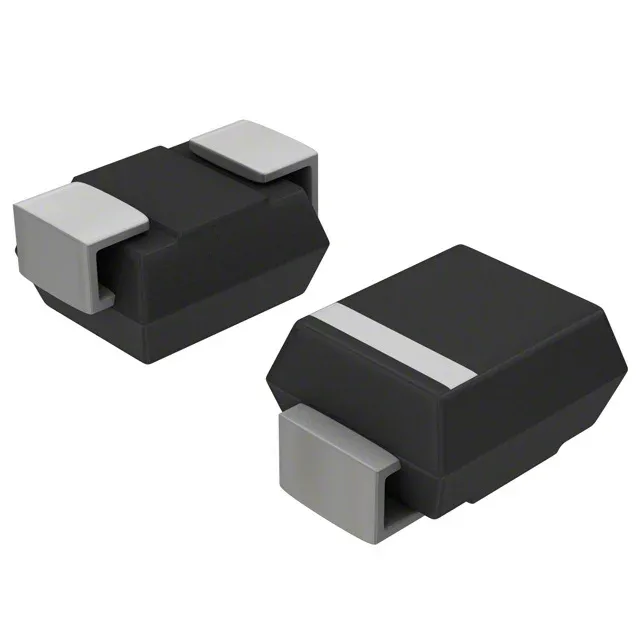
What this TVS diode does on the board
It handles a peak pulse power of 400 W (10/1000 µs waveform) and clamps at 21.7 V max at the rated peak pulse current of 106 A (8/20 µs waveform). The breakdown voltage range starts at 11.1 V min, so it triggers before the protected circuitry sees damaging overvoltage.
For a 10 V rail, that translates to a peak current capability of 106 A under the 8/20 µs waveform used for ESD and surge testing. The 21.7 V clamping voltage tells you the maximum voltage the downstream components must survive. If your load has a 20 V absolute maximum on the supply pin, this part holds the clamp below that threshold — but check the margin at your specific operating current.
With a single bidirectional channel, the SM4T12CAY clamps positive and negative transients symmetrically. That simplifies BOM and layout on AC-coupled lines or signal pairs where polarity isn't fixed. The reverse standoff voltage is 10 V — the rail voltage it leaves alone during normal operation. No power line protection (it's not designed for continuous overvoltage), so it's a pure transient suppressor.
DO-214AC (SMA) — rework and footprint
Housed in a DO-214AC (SMA) surface-mount package, the SM4T12CAY is a standard two-terminal part. The SMA body is small enough for dense layouts but large enough to hand-rework with a hot-air station without lifting the pad — the thermal mass is manageable. Orientation is straightforward: the cathode band marks the reference for the unidirectional version, but on this bidirectional part the marking identifies the part number, not polarity. The package footprint matches standard SMA land patterns; no special pad geometry needed beyond the datasheet recommendation.
No last-time-buy or obsolescence risk to budget around.