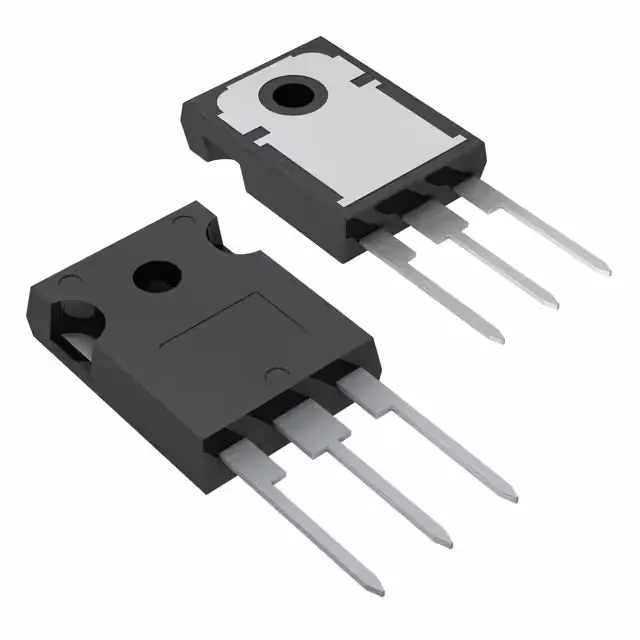
It comes in a through-hole TO-247-3 package (ST's HiP247 variant), the standard footprint for high-voltage discrete switching in PFC stages, LLC converters, photovoltaic inverters, and auxiliary power supplies. The SiC technology gives this part a 690 mOhm maximum on-resistance at 6 A with a 20 V gate drive, and a junction temperature range from -55°C to 200°C — notably wider than typical Si MOSFETs, which matters for designs that must survive thermal cycling or high ambient conditions.
Switching and drive — gate charge and capacitance
Input capacitance measures 290 pF at 400 V drain-source, so the Miller plateau is narrow and the switching losses stay manageable in hard-switched topologies.
Thermal and power dissipation — sizing the heatsink
In practice, a 12 A continuous drain at 1200 V is a switching application, not linear — the conduction loss at 6 A with 690 mOhm Rds(on) is about 25 W, and the switching loss adds depending on frequency. The TO-247 package with its large tab can bolt to a heatsink or a cold plate; the junction-to-case thermal path is the limiting factor for continuous current above 6 A. The -55°C to 200°C junction range means the part can be used in engine-bay, downhole, or aerospace auxiliary power designs where ambient exceeds 125°C, as long as the case is kept within the derating curve.
For a production BOM, there is no imminent LTB risk, but SiC devices are still in a supply-constrained market — qualifying an alternate from the same or a second SiC vendor is prudent for high-volume builds.