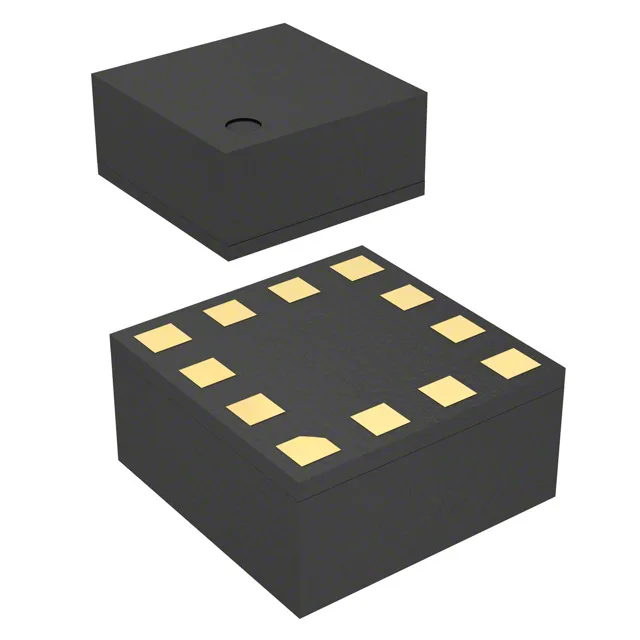
Sensor fusion in a 2x2 mm footprint
The digital output is available over I²C or SPI, selectable by the bus configuration — both interfaces operate at standard clock rates and share the same pinout, so the same PCB layout supports either protocol. Housed in a 12-VFLGA package measuring 2x2 mm (supplier device package 12-LGA), the LSM303AGRTR fits into space-constrained designs such as wearable orientation trackers, portable navigation aids, and IoT sensor nodes where board area is at a premium.
The 12-VFLGA package is a surface-mount land-grid array with a 2x2 mm body — the 12 pads are on the bottom face, requiring a solder-paste stencil with apertures matching the pad layout in the ST application note. The low profile (typical 0.9 mm seated height) allows placement under shielding cans or in thin-profile enclosures. Packaging options include Tape & Reel (TR) for automated pick-and-place in volume production and Cut Tape (CT) for prototype or low-quantity builds — both are standard reel formats compatible with common feeder widths.
Peer comparison — LSM6DSV16XTR
The LSM6DSV16XTR is a 6-axis inertial measurement unit (IMU) that adds a gyroscope to the accelerometer and temperature — it does not include a magnetometer. The LSM303AGRTR provides magnetometer output for heading, which the LSM6DSV16XTR lacks. The two parts are not pin-compatible; the LSM6DSV16XTR uses a different package and register map, so a board spin is required to swap between them.