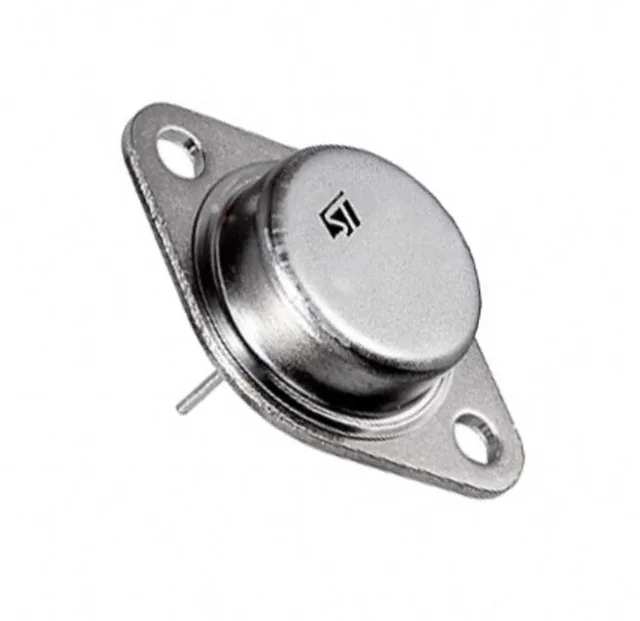
Negative rail workhorse in a TO-3 can
The LM337K is a negative adjustable voltage regulator from Texas Instruments, delivering up to 1.5A output current in the TO-3 steel hermetic package. It accepts an input voltage up to 40V and produces an adjustable output from -1.2V down to -37V, set by two external resistors. This is the negative complement to the positive regulator family — same three-terminal adjustable architecture, inverted polarity. The TO-3 metal case provides a low thermal resistance path to a heatsink.
PSRR and ripple rejection across the line frequency band
Power supply rejection ratio is specified at 77dB to 60dB at 120Hz, which covers the fundamental and second harmonic of full-wave rectified 60Hz mains. At 77dB, the output ripple from a 1V peak-to-peak input ripple is attenuated to roughly 140µV — adequate for most analog audio and instrumentation negative rails. The PSRR rolls off with frequency; the 60dB figure at the upper end of the 120Hz band still provides 1000:1 rejection. For designs requiring better high-frequency rejection, a post-regulator LC filter or a lower-noise LDO in a surface-mount package would be a more modern choice.
1.5A output with over-current and over-temperature protection
Rated for 1.5A continuous output, the LM337K includes internal over-current and over-temperature protection. The current limit folds back under fault conditions, and the thermal shutdown threshold prevents die damage if the heatsink is undersized. In practice, the usable output current is derated by the input-output differential and the thermal resistance of the TO-3 package to the heatsink. At 15V differential and 1.5A, the die dissipates 22.5W — the TO-3 case needs a substantial heatsink or forced airflow to keep the junction below the 125°C maximum operating temperature.
Obsolete — sourcing strategy for sustainment programs
Texas Instruments no longer manufactures this part in the TO-3 package. For new designs, the surface-mount TO-263 (D2PAK) or SOIC-8 variants of the LM337 family are the recommended active alternatives, though they are not pin-compatible with the TO-3 footprint.