AEC-Q100 grade-1 temperature ceiling and what it means for the BOM
The LM258AWDT: An OEM auditor will expect PPAP documentation confirming the 105°C limit was tested to the full temperature cycle, not just the functional range.
Bandwidth and slew-rate — where the signal chain stops being linear
Gain-bandwidth product is 1.1 MHz typ. With a closed-loop gain of 10, the small-signal bandwidth settles at 110 kHz — adequate for filtering wheel-speed sensor outputs or conditioning thermocouple signals before the ADC. The 0.6 V/µs slew rate limits the full-power bandwidth: at a 10 Vpp output swing, the amplifier slews before it reaches roughly 95 kHz. Above that frequency, the output distorts into a triangle wave rather than a sine.
Supply rails and quiescent draw — always-on module fit
Supply span runs from 3 V up to 30 V — the same dual op-amp works on a 5 V logic rail, a 12 V battery line, or a 24 V truck system without a separate regulator. Each amplifier draws 700 µA supply current, so both channels together pull 1.4 mA quiescent. In an always-on ECU monitoring a parked vehicle, that current sits below the module's sleep-mode budget and avoids draining the battery over weeks.
Input offset and bias — sensor front-end limits
For a 10-bit ADC with a 5 V reference, the 1 mV offset contributes roughly 0.2 LSB of systematic error — negligible unless the application requires better than 0.1% accuracy without a calibration step. The 20 nA bias current into a 10 kΩ source resistor drops 200 µV, which is below the offset itself, but into a 1 MΩ sensor the 20 mV drop dominates the error budget.
Output drive and package
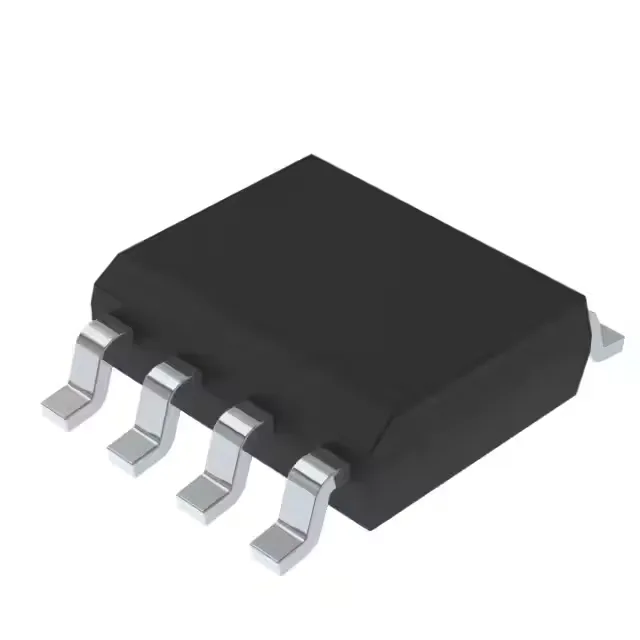
Each channel can source or sink 60 mA — enough to drive the analog input of a typical automotive ADC or a small relay coil through a series resistor. The 8-SOIC package (3.90 mm body width) is the standard SO-8 footprint; the layout matches any existing board designed for a generic dual op-amp. The supplier device package is listed as 8-SOIC, so the marking on the reel matches the PCB land pattern.
Lifecycle and sourcing posture
ROHS3 compliant — no exemption expiry to track for 2026 designs. The part is in the STMicroelectronics Automotive AEC-Q100 catalog, so full PPAP and production-part approval documentation is available through the supply chain.