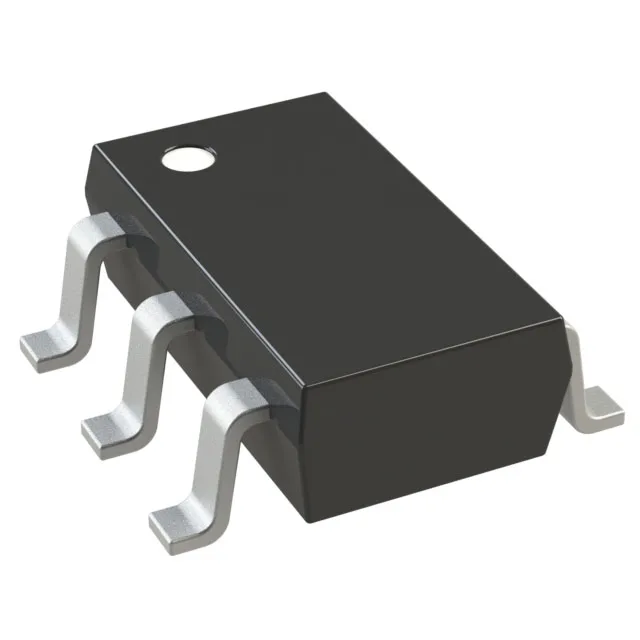
300 mA LDO with 0.4 V dropout — the headroom budget
The LDK130M28RY is a single-output positive fixed LDO delivering 300 mA at 2.8 V. The 0.4 V maximum dropout at full load means the input rail must stay above 3.2 V across the load range to keep the output in regulation — a 5 V nominal supply with 10% tolerance still leaves 1.3 V of headroom at the low end. Quiescent current is 60 µA typical, rising to 120 µA max including the shutdown and bias overhead. For an always-on ECU module drawing 10 mA, the LDO's own consumption adds 0.6% to the load — negligible, but in a sleep-state pulling 100 µA the Iq becomes the dominant term.
55 dB PSRR across 120 Hz to 10 kHz — what it means for noise-sensitive rails
Power supply rejection ratio is specified at 55 dB from 120 Hz through 10 kHz. That is the band where automotive alternator ripple (360 Hz for a 6-pole machine at 1800 rpm) and DC-DC converter switching noise (typically 200 kHz to 2.2 MHz) sit. At 55 dB, a 100 mVpp ripple on the input is attenuated to roughly 180 µVpp at the output — clean enough for a 10-bit ADC reference rail but marginal for a 16-bit sensor front-end without additional post-filtering.
AEC-Q100 Grade 1 — the temperature envelope
Rated for -40°C to 125°C junction temperature, this LDO meets AEC-Q100 Grade 1 qualification. That is the under-hood temperature band — an engine-control unit or transmission controller that sees 105°C ambient on a summer-grade still has 20°C of junction margin before the thermal shutdown trips. The over-temperature and over-current protection circuits are integrated, so a shorted output or a stalled fan on the heatsink does not cascade into a board fire.
SOT-23-5 footprint and supply rails
Packaged in SOT-23-5 (SC-74A), the LDK130M28RY uses the standard 5-lead small-outline transistor footprint. The enable pin (active high) lets the system microcontroller gate the LDO output — pulling it low drops the output to zero and cuts the supply current to the shutdown leakage floor. Input voltage range is 2.5 V to 5.5 V, compatible with 3.3 V and 5 V automotive buses.