200 mA LDO with 55 dB PSRR — the rail-cleaner for noise-sensitive analog supplies
The STMicroelectronics LDK120C11R is a 200 mA fixed-output LDO regulator delivering 1.1 V from a maximum 5.5 V input rail. Its 55 dB power-supply rejection ratio holds flat from 120 Hz through 10 kHz, which means it filters switching-regulator ripple and line-frequency hum across the audio band and into the low-MHz switching range — a clean analog rail for sensor front-ends, codec supplies, or ADC reference buffers. The 0.3 V maximum dropout at the full 200 mA load gives you 300 mV of headroom between the input rail and the 1.1 V output before the regulator falls out of regulation. That is tight enough that the input rail should be regulated — a 1.4 V or 1.5 V bus is the practical minimum; a 1.2 V rail leaves no margin at load.
Quiescent draw and protection — battery-friendly with built-in safeguards
Quiescent current is 60 µA typical, with a maximum supply current of 100 µA. For a battery-powered sensor that spends most of its time in a low-power state, the regulator's own draw is well below the self-discharge rate of a coin cell — the load current, not the LDO, sets the sleep budget. On-chip protection includes over-current and over-temperature shutdown. The enable pin lets a GPIO or a supervisor IC gate the output rail, dropping the load entirely when the system sleeps.
SOT-323-5 footprint — rework-friendly, but watch the thermal pad
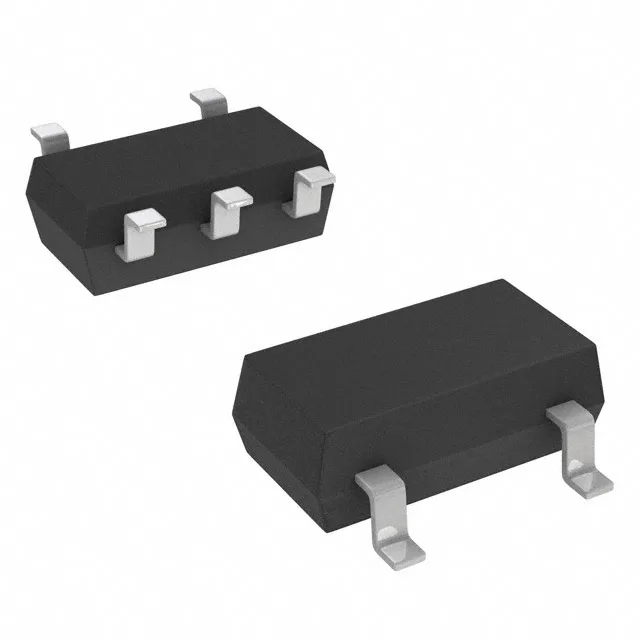
The LDK120C11R comes in a 5-lead SOT-323-5 (also listed as SC-70-5 or SOT-353). That is a 2.0 mm × 2.1 mm body with 0.65 mm lead pitch — small enough to fit tight layouts, but the leads are on the sides, not under the package, so a standard fine-tip iron or hot-air station can get at them. At 200 mA output with a 3 V input-to-output differential, the package dissipates 600 mW — the SOT-323-5's junction-to-ambient thermal resistance (typically around 250 °C/W on a standard FR4 board) means the die temperature stays under 125 °C only if the ambient is below about 85 °C. For higher ambient or higher dropout, the copper pour area under the paddle is what keeps the part alive.
Active production — no end-of-life pressure on this BOM line
The LDK120 family includes fixed-output voltage variants at 1.0 V, 1.2 V, and 2.8 V (LDK120C10R, LDK120C12R, LDK120C28R) in the same SOT-323-5 package and pinout — a BOM that needs a different rail voltage can swap the order code without a board spin.