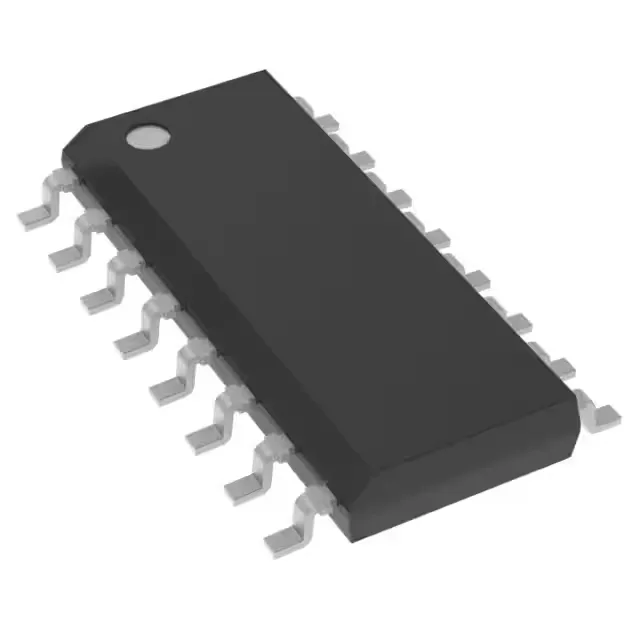
Dual op-amp with 1 A output drive
Each of its two independent channels can source or sink up to 1 A of output current — this is the standout parametric that separates it from a garden-variety dual op-amp. The 1 A output capability means the L272D013TR can directly drive resistive or inductive loads — solenoids, relay coils, small DC motors, or audio transducers — without an external buffer transistor. For a dual op-amp in a standard SOIC footprint, that output current rating is unusual and defines the part's application space. Gain-bandwidth product is 350 kHz with a slew rate of 1 V/µs. This is not a high-speed signal-processing amplifier; the bandwidth limits it to low-frequency servo loops, DC level shifting, transducer excitation, or audio baseband below 20 kHz. The 1 V/µs slew rate means the large-signal response into a capacitive load will be the limiting factor, not the GBW.
Supply flexibility and input-stage character
Supply span runs from 4 V minimum to 28 V maximum, supporting single-rail operation (e.g., 5 V, 12 V, 24 V) or split supplies up to ±14 V. The 8 mA quiescent supply current per device is moderate — the bias current is dominated by the output stage's standing current, not the input pair. This is not a precision or low-offset amplifier; for gains above 100, the offset multiplied by gain may saturate the output. The 16-SO package (supplier device package 16-SO) is a standard JEDEC outline with 1.27 mm pitch, compatible with most automated assembly lines.
No official successor or cross-reference is listed by the manufacturer. For BOM continuity, the active status means no last-time-buy planning is required today.