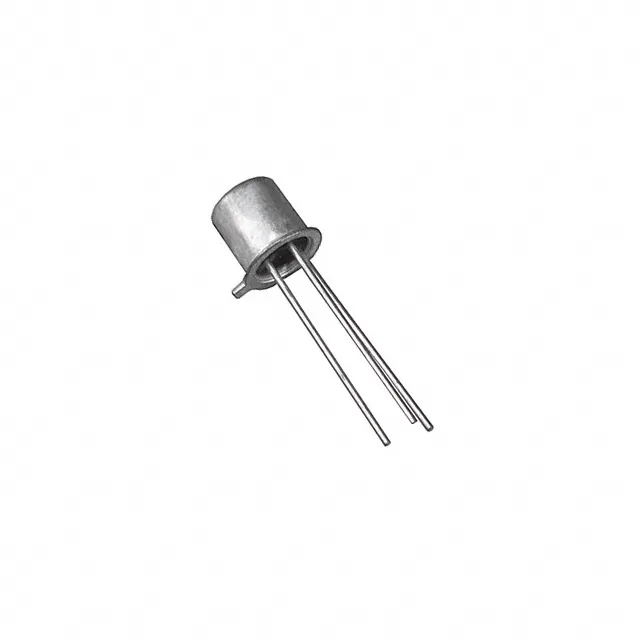
PNP switching transistor in a TO-18 can
The 2N2907A is a PNP general-purpose switching transistor in a TO-18 metal can package (TO-206AA). It's the higher-gain variant of the classic 2N2907, with a minimum DC current gain (hFE) of 100 at 150 mA collector current and 10 V Vce. Collector-emitter breakdown is rated at 60 V, collector current at 600 mA, and power dissipation at 400 mW — numbers that put it in the medium-current, medium-voltage sweet spot for switching loads, relay drivers, and linear regulators in older designs. The 200 MHz transition frequency means it handles modest-speed switching without trouble. Junction temperature is rated to 175°C, so it survives hot environments like engine bays or industrial cabinets, but the TO-18 metal can needs a heatsink or good airflow to dissipate that 400 mW at elevated ambient.
For a production BOM, you cannot order fresh factory stock. The part is available only through the surplus and independent distribution channel — which is exactly where we source it. If you are qualifying a replacement, the 2N2907A's close relatives — the 2N2907 (lower hFE floor) or the 2N2905A (same die in a TO-39 package) — are also obsolete. A modern SMD equivalent like the MMBT2907A (SOT-23) or PZT2907A (SOT-223) may be a better fit for new designs, but check the pinout and thermal derating.
The 60 V Vce breakdown gives you headroom for a 48 V rail or a 24 V inductive load with flyback. The 600 mA collector current is a continuous rating — don't plan on switching a 500 mA load at high duty cycle without looking at the SOA curve (not in this listing, but the datasheet's safe-operating-area graph is your friend). The 1.6 V Vce saturation at 50 mA base / 500 mA collector is typical for a PNP of this era; it means the transistor drops about 1.6 V when fully on, so at 500 mA you're dissipating 0.8 W in saturation alone — above the 400 mW package limit, so you need to pulse or heatsink. The 10 nA collector cutoff leakage is tight, good for high-impedance switching. The 200 MHz ft is fine for audio and low-speed PWM, but don't expect clean switching above a few MHz without base-drive shaping.