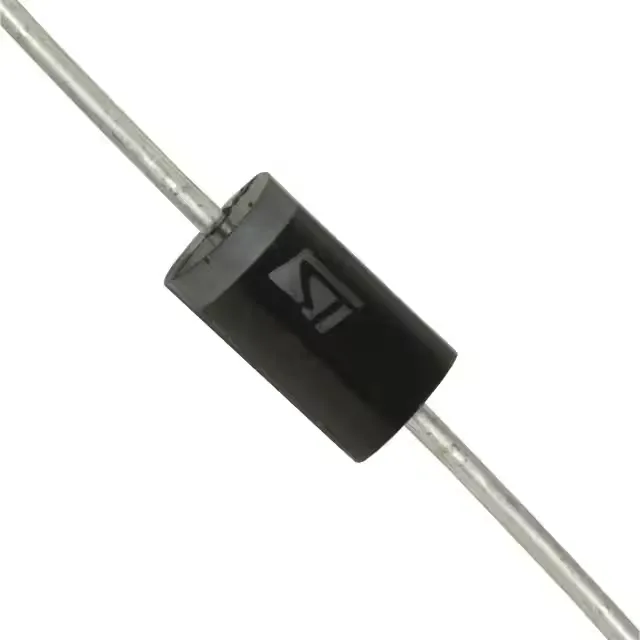
The STMicroelectronics 1.5KE6V8CARL is a TRANSIL™ bidirectional TVS diode rated for 1500 W peak pulse power (10/1000 µs waveform). That 1.5 kW rating means it can clamp a 746 A surge (8/20 µs) down to 13.4 V, making it a solid choice for protecting a 5 V or 3.3 V rail against inductive load dumps, lightning-induced transients, or ESD events in industrial and telecom gear. The reverse standoff voltage of 5.8 V and minimum breakdown of 6.45 V set the trigger window — the diode stays off below 5.8 V and starts conducting by 6.45 V, so a 5 V supply rail sees no leakage under normal operation. The 13.4 V clamp is the ceiling; downstream circuitry needs to survive that peak for the pulse duration.
Bidirectional — one part covers both polarities
This is a single bidirectional channel, so it clamps equally on positive and negative transients. No need to series two unidirectional diodes or worry about orientation on the PCB. The symmetrical breakdown characteristic is useful on AC signal lines or on DC rails where the return path can see a negative spike relative to ground.
Package and mounting — DO-201 axial leaded
Through-hole DO-201AA / DO-27 axial package. The leads are tin-plated copper; the body is molded epoxy. For a rework tech, this is a straightforward hand-solder or wave-solder part — no reflow profile to worry about. The axial leads mean it can be inserted vertically or bent flat depending on board clearance.
Capacitance — 4750 pF at 1 MHz
The 4750 pF capacitance is typical for a high-power TVS of this voltage class. That capacitance loads the line, so this part is not ideal for high-speed data interfaces (USB 2.0, Ethernet, CAN FD) without careful signal-integrity analysis. It is better suited for power supply inputs, relay driver outputs, or other low-frequency nodes where the added capacitance does not degrade the signal.
Lifecycle — active, no end-of-life watch
STMicroelectronics continues to manufacture this part, so there is no LTB or EOL pressure on your BOM. The TRANSIL™ 1.5KE family has been a long-running product line, and the active status means you can plan multi-year production without worrying about a sudden discontinuation notice. That said, always check the latest PCN from ST before a new design-in — active parts occasionally get package or wafer fab changes that affect date-code traceability.