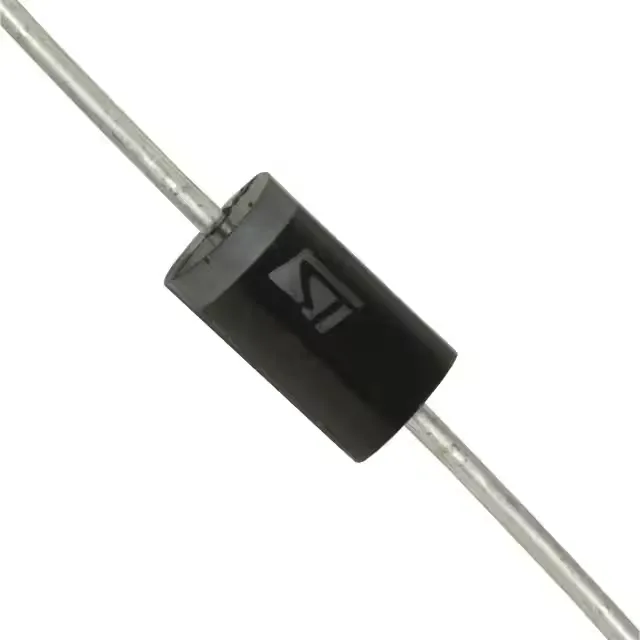
What this TVS is and what it protects
It delivers 1500W peak pulse power (10/1000µs waveform) with a reverse standoff voltage of 213V and a maximum clamping voltage of 442V at the rated peak pulse current of 23A (8/20µs waveform). The single unidirectional channel means it protects one polarity — positive transients above the breakdown threshold are shunted to ground; reverse polarity is not clamped.
The 1.5KE250ARL is listed as obsolete. STMicroelectronics no longer manufactures this exact suffix variant. The good news: the 1.5KE series is a mature, widely cloned TVS family, and the 1.5KE250A (without the R or L suffix) is a common pin-compatible alternative from multiple manufacturers — same DO-201 package, same 213V standoff, same 1500W rating. When sourcing, confirm the breakdown voltage window (237V minimum) and clamping voltage (442V maximum) match, and verify the unidirectional polarity marking — the cathode band should be present on the body.
This part comes in a DO-201AA (DO-27) axial-lead through-hole package. The body is about 9.5 mm long with 0.96 mm diameter leads — standard for the 1.5 kW class. Mounting is straightforward: through-hole into a board with 1.2 mm drilled holes, or you can solder the leads directly to a terminal. The axial leads are tinned and solderable with a standard iron or wave. No special thermal management needed for single-pulse transients; the lead frame and body handle the 1500W pulse within the rated waveform. If you are replacing a failed part on a board, the scorch mark around the body is usually obvious — the part fails shorted, which takes down the rail. A visual check for a cracked or bulged epoxy body confirms it.
Capacitance and frequency considerations
The 1.5KE250ARL has a typical capacitance of 560 pF at 1 MHz. That matters if you are protecting a high-speed data line — 560 pF will load the signal and roll off the edge rate above a few MHz. For a 213V rail, that is not usually a concern; this part is meant for DC power buses, not Ethernet or USB. If you need to protect a faster interface at a lower voltage, look at a lower-capacitance TVS array (e.g., the STMicroelectronics ESDA series). But for a 48V telecom bus or a 170V DC link, 560 pF is negligible.