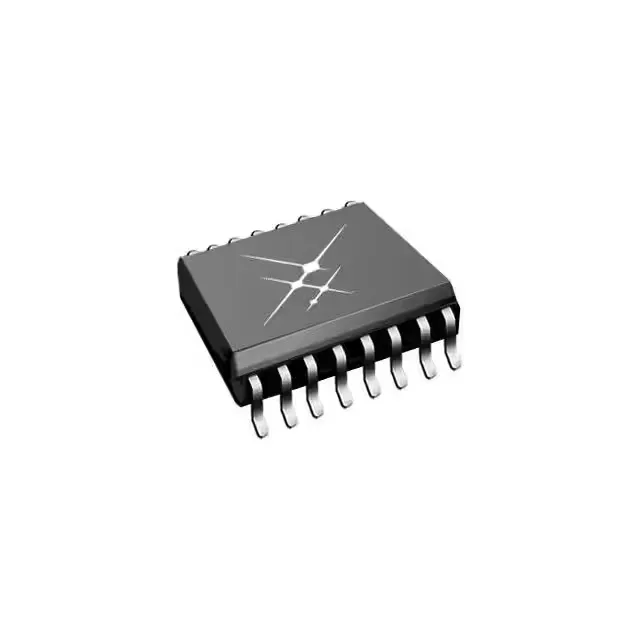
5-channel, 150 Mbps capacitive isolator for industrial signal chains
The Skyworks Solutions SI8652BB-B-IU is a 5-channel digital isolator using capacitive coupling technology, rated for 150 Mbps data rate and 2500 Vrms isolation voltage. The 3/2 input/output distribution (three channels on side 1, two on side 2) suits unidirectional signal paths where the majority of data flows from one domain to the other.
Timing margins and transient immunity for reliable data transfer
Propagation delay is 13 ns max (tpLH / tpHL), with a pulse width distortion of 4.5 ns max. For a 150 Mbps NRZ signal (6.67 ns unit interval), the 13 ns delay means the isolator adds roughly two bit periods of latency — a factor to budget in closed-loop control or time-sensitive sensor readouts. Common mode transient immunity is rated at 50 kV/µs minimum. This is the key parameter for motor-drive or inverter applications where fast-switching SiC/GaN stages generate high dV/dt across the isolation barrier. A 50 kV/µs CMTI ensures the output does not glitch when the ground plane jumps several hundred volts in nanoseconds. Rise and fall times are 4 ns typical. The 4 ns edges, combined with the 13 ns propagation delay, set the maximum practical signalling rate below the 150 Mbps ceiling when driving capacitive loads above 15 pF — the output slew rate into the load adds to the propagation delay budget.