Isolation for a noisy backplane
The SI8641BB-B-IU is a 4-channel general-purpose digital isolator from Skyworks' Si864x family, built around capacitive coupling technology. It delivers 2500Vrms of galvanic isolation, which is the standard barrier for breaking ground loops between a 24V fieldbus interface and a 3.3V controller core in an industrial PLC or motor-drive control board. The 35kV/µs common-mode transient immunity (CMTI) means this part can sit on a gate-driver side of a motor-drive inverter without the isolation barrier latching up or dropping bits during a fast-switching event. For a 600V IGBT bridge switching at 10-20 kHz, the common-mode slew rate across the barrier can exceed 10 kV/µs; the 35 kV/µs rating gives a solid 3x margin.
Data rate and timing for the signal chain
Rated for 150 Mbps, the isolator handles high-speed SPI buses (up to 50 MHz quad-SPI) and parallel data links without adding a clock-cycle penalty. The 13 ns max propagation delay (tpLH / tpHL) is symmetric, so the pulse-width distortion stays under 4.5 ns — critical for maintaining duty cycle on a PWM signal or a Manchester-encoded fieldbus like RS-485. The 2.5 ns typical rise/fall time means the output edges are fast enough for 150 Mbps but not so aggressive that they cause crosstalk on a tightly packed 16-pin SSOP layout.
Channel assignment and supply flexibility
Four unidirectional channels, configured as three on side 1 and one on side 2. This 3/1 split is typical for isolating a 3-wire SPI bus (SCLK, MOSI, CS) from the controller to the peripheral, with the MISO return channel on the isolated side. The unidirectional architecture means no bidirectional data lines — plan for a separate isolator or a discrete buffer if the bus needs bidirectional signalling. No external level shifter needed between the two domains — the isolator handles the translation internally.
Temperature grade and field servicing
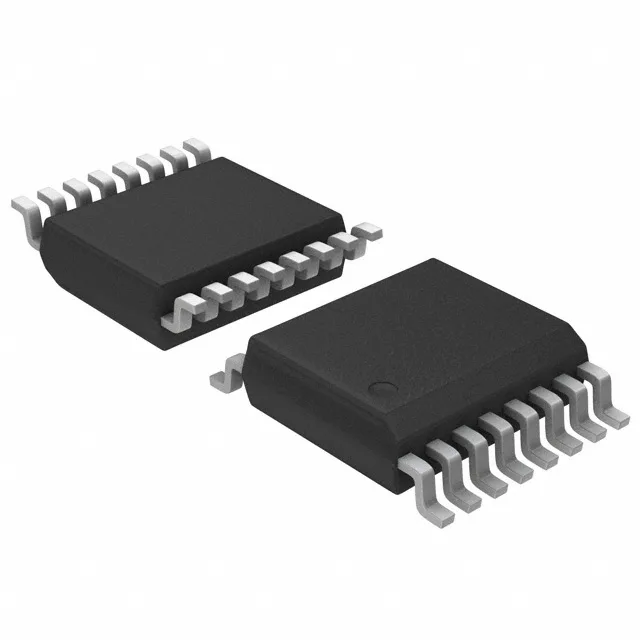
It survives the inside of a motor junction box in summer and a cold-start PLC cabinet in a Canadian winter. Surface-mount 16-SSOP with 0.154-inch (3.90 mm) body width — a standard fine-pitch SOIC footprint. No exposed pad, so solder paste volume is less critical than on a QFN.