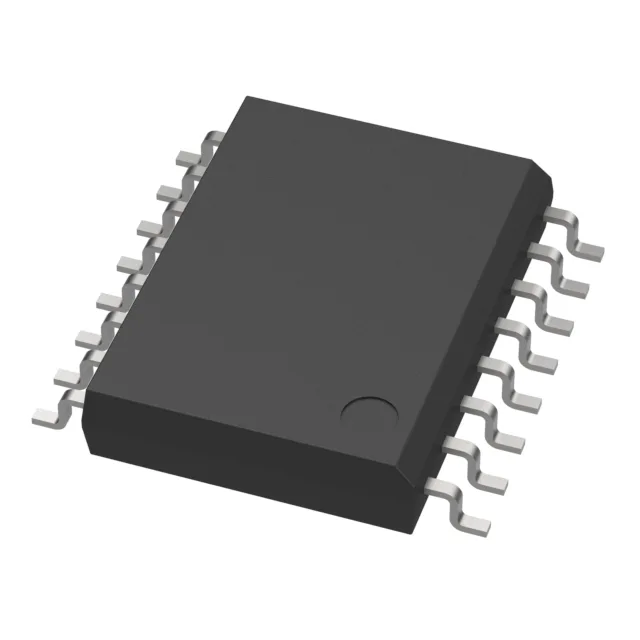
5000 Vrms isolation — the safety barrier that defines the part
The SI8622ET-IS: Rated for 5000 Vrms of galvanic isolation, this digital isolator provides reinforced insulation between two ground domains. That rating covers medical equipment (IEC 60601-1 patient protection), industrial motor drives (IEC 61800-5-1), and any system where a fault on the high-voltage side must not propagate to the low-voltage control electronics. The 16-SOIC wide-body package (7.50 mm body width) provides the physical creepage and clearance needed to sustain that isolation voltage across the package surface — a standard footprint for automated pick-and-place and reflow assembly.
150 Mbps and 60 kV/µs CMTI — the speed and noise rejection that matter
At 150 Mbps, this part handles SPI clock rates up to 75 MHz half-duplex, full-duplex UART at any common baud rate, and general-purpose digital signal isolation without introducing timing bottlenecks. The 13 ns propagation delay is symmetric (tpLH = tpHL both 13 ns max), so pulse-width distortion stays at 4.5 ns max — important for maintaining duty cycle across the barrier. Common-mode transient immunity is rated at 60 kV/µs minimum — this is the part's ability to reject fast voltage transients that couple capacitively across the isolation barrier. In a motor-drive application where the IGBT switching edges create 10–20 kV/µs common-mode swings, 60 kV/µs provides a 3× margin before data corruption occurs.
2-channel unidirectional — the channel map for isolated SPI or UART
Two unidirectional channels with one input on Side 1 and one input on Side 2 — this 1/1 split is the natural fit for an isolated SPI bus (SCLK forward, MISO reverse) or an isolated UART (TX forward, RX reverse). The capacitive coupling technology uses silicon dioxide isolation capacitors — these offer faster data rates and lower power than optocouplers, with no LED degradation over lifetime.