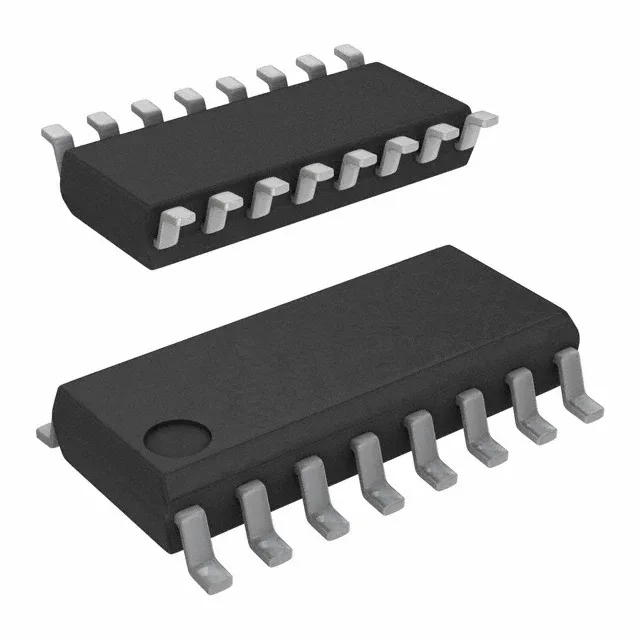
16-SOIC package and board-fit story
The SI8273AB-IS1R comes in a 16-SOIC narrow-body package (3.90 mm body width) with a 1.27 mm pitch — a standard footprint that routes cleanly on a two-layer board for most gate-drive layouts. Surface-mount only; the 0.154-inch width keeps the creepage distance tight, so the 2500Vrms isolation rating depends on maintaining the datasheet's recommended PCB slot or gap under the part. The supplier device package is listed as 16-SOIC, which is the same mechanical outline as the SOIC-16 narrow. For high-frequency switching, keep the output return path short and wide to minimise loop inductance.
What the 4 A peak output and 150 kV/µs CMTI mean for your gate drive
Rated for 4 A peak output current (1.8 A source, 4 A sink), this isolator drives the gate of a medium-power IGBT or Si MOSFET directly — think 600 V / 30 A class devices switching at 20–100 kHz. The asymmetric sink/source ratio (4 A pull-down vs 1.8 A pull-up) means the turn-off edge is faster than turn-on, which helps clamp the gate during Miller plateau events without an external pull-down resistor. Common-mode transient immunity of 150 kV/µs minimum means the output stays valid when the ground reference on the secondary side jumps at tens of kilovolts per microsecond — exactly what happens in a half-bridge when the low-side FET turns off and the switch-node voltage slews across the isolation barrier. Below this threshold, the part holds its logic state; above it, the output may glitch. For motor-drive and inverter applications, 150 kV/µs is the floor for reliable operation in a noisy environment. Propagation delay is matched at 60 ns max for both rising and falling edges, with a pulse-width distortion of just 8 ns. That symmetry matters when the isolator feeds a dead-time generator — the 8 ns skew between channels is well within the margin for a 500 ns dead-time window in a typical inverter leg.
Temperature range and supply rail flexibility
The output supply rail accepts 4.6 V to 30 V, so it can drive the gate of a standard IGBT (typically 15 V) or a logic-level MOSFET (down to 5 V) from the same secondary-side bias rail. No separate regulator needed between the bias supply and the isolator output. Rise and fall times are 10.5 ns and 13.3 ns typical respectively — fast enough to keep switching losses low in a 100 kHz converter, but the 13.3 ns fall time (sink) is the edge that determines the di/dt in the gate loop. Pair it with a gate resistor in the 5–15 Ω range to control ringing without slowing the edge below the datasheet typical.
Active lifecycle and compliance — approvals on record
The Si827x series is a current-production family, so the SI8273AB-IS1R is suitable for new designs and volume builds. Carries CQC, CSA, UR, and VDE approvals — these are the key safety agency marks for reinforced insulation in industrial equipment. The UR (UL recognition) and VDE marks cover the 2500Vrms isolation rating for basic or reinforced insulation per IEC 60950-1 / IEC 62368-1.